

Table of Contents
- Why More Options Haven’t Made This Decision Easier
- What Is a Hyaluronic Acid BBL and How Does It Work?
- HA BBL vs. Sculptra vs. Surgical BBL: A Side-by-Side Decision Framework
- Who Is the Ideal Candidate for Hyaluronic BBL, and Who Genuinely Isn’t
- What Results Can You Realistically Expect, and How to Evaluate Them Honestly
- Safety Profile, Side Effects, and the Reversibility Advantage
- How Long Does Hyaluronic BBL Last, and How to Extend It Intelligently
- Combination Approaches: When Hyaluronic BBL Performs Best as Part of a Layered Protocol
- Hyaluronic BBL Cost vs. Surgical BBL: Evaluating the Investment Across Your Timeline
- Conclusion: Your Silhouette, Your Decision — and What an Expert Assessment Changes
- Frequently Asked Questions
Why More Options Haven’t Made This Decision Easier
Having three viable paths to gluteal enhancement — hyaluronic acid filler, Sculptra, and surgical BBL — sounds like good news. In practice, it creates a decision that most patients are poorly equipped to make. Not because they lack intelligence, but because the information available to them is almost uniformly designed to sell a specific procedure rather than match them to the right one.
Most content you’ll encounter positions each option as broadly suitable, downplays its limitations, and competes on before-and-after photography rather than clinical candidacy. The result is a patient population that arrives at consultations having done significant research and still holding the wrong mental model for their situation.
More options without better decision criteria simply multiplies the ways to get it wrong.

The Real Risk Is Misalignment, Not the Procedure Itself
Every option covered in this guide — hyaluronic BBL, Sculptra, and surgical BBL — has a legitimate role in aesthetic medicine. Each has a safety profile, a mechanism, and a population of patients for whom it produces genuinely excellent results. The clinical risk is not inherent to any of them individually.
The financial and emotional risk lies in misalignment: choosing volume-building filler when skin laxity is the actual problem, pursuing a surgical procedure when your lifestyle cannot accommodate six weeks of restricted activity, or selecting Sculptra when you need immediate, visible change rather than gradual collagen development over months.
Misalignment doesn’t always produce catastrophic outcomes. More often it produces results that are technically adequate but personally disappointing, which, after investing thousands of dollars and your trust, is its own kind of failure.
How This Guide Helps You Determine Which Path Is Actually Yours
This guide is structured as a decision framework, not a product endorsement. Each section is designed to give you one more filter for narrowing down which option genuinely fits your body, your goals, and your life.
By the time you reach the end, you should be able to place yourself in one of three candidacy profiles with reasonable confidence, and walk into a consultation already understanding why that path makes sense for you specifically.
What Is a Hyaluronic Acid BBL and How Does It Work?
The Science Behind Cross-Linked HA and Gluteal Volume Correction
Hyaluronic acid is a polysaccharide that occurs naturally in connective tissue. In its native form, it degrades rapidly. Cross-linking — the process of chemically bonding HA molecules into a stable three-dimensional matrix — is what transforms it into a durable injectable filler capable of maintaining structural volume in high-movement tissue like the gluteal region.
For gluteal augmentation specifically, the filler must resist the mechanical demands of sitting, movement, and tissue compression while maintaining a natural feel. This requires formulations engineered at a higher viscosity and cohesivity than anything used in facial aesthetics. Standard facial fillers are not appropriate here, and providers who use them for gluteal work are operating outside the clinical rationale for cross-linked HA entirely.
HYAcorp MLF1 vs. MLF2: Why Formulation Specificity Changes Everything
Not all body fillers are interchangeable. HYAcorp’s two body-specific formulations exist because different anatomical zones have different structural requirements, and using a single product across all areas of gluteal augmentation produces suboptimal results.
MLF1: Viscosity Profile, Cross-Linking Density, and Lateral Hip Application
MLF1 has a lower viscosity profile relative to MLF2, which makes it better suited for areas requiring refined contour work rather than significant projection. Its primary application is in lateral hip and hip dips correction, where the goal is smooth volume integration along the outer silhouette. The lower cohesivity allows it to spread more naturally through tissue planes in areas where firmness would look and feel unnatural.
MLF2: High-Cohesivity Performance and Gluteal Projection Outcomes
MLF2 is the workhorse for posterior projection. Its higher cross-linking density creates a more structured gel that holds shape under compressive load, which is exactly what the central gluteal mass requires to maintain volume over time. When a patient wants measurable projection rather than contour refinement, MLF2 is the appropriate choice. Using MLF1 in the central buttock would deliver inadequate lift and accelerated degradation under normal daily pressure.
Subdermal Depot Placement: What Anatomical Precision Looks Like in Practice
The clinical outcome of a hyaluronic BBL is determined less by the product itself than by where and how it is placed. Product is deposited in discrete subdermal depots using cannulas rather than needles, which reduces vascular trauma and allows the practitioner to position volume with greater accuracy across the gluteal topography.
Placement depth matters considerably. Too superficial and the filler creates visible irregularity. Too deep and it migrates under tissue load. The correct plane keeps product stable, palpably natural, and positioned to resist the physical demands placed on this area daily.
Is Hyaluronic Acid Good for BBL? What Clinical Evidence Shows
Clinical data on HA-based gluteal augmentation is more robust than many patients expect. Studies using HYAcorp body fillers have documented measurable improvements in gluteal projection and contour, with high patient satisfaction rates reported at 12-month follow-up. Side effect profiles in this research are consistent with what clinicians observe in practice: transient swelling, bruising, and mild discomfort resolving within one to two weeks, with no serious adverse events in appropriately screened candidates.
The honest answer to whether hyaluronic acid is good for BBL is: yes, within a defined scope. It produces reliable results in patients who need moderate volume augmentation, contour refinement, or hip dips correction. It does not replicate the volume capacity of surgical fat transfer, and it is not the right tool when the clinical need exceeds what injectable volume can address.
HA BBL vs. Sculptra vs. Surgical BBL: A Side-by-Side Decision Framework
Why Generic Comparisons Fail the Research-Driven Patient
Most procedure comparisons are structured to highlight one option’s superiority across all variables. That framing is clinically dishonest. Each of these three approaches leads in different categories, and those categories correspond directly to what individual patients actually prioritize. A comparison that tells you one option is “best” is really telling you it matches the author’s preferred patient profile, not yours.
The framework below is built around the variables that change your decision, not the variables that all three options share.
The Eight-Variable Comparison
| Variable | Hyaluronic BBL | Sculptra | Surgical BBL |
|---|---|---|---|
| Mechanism | Immediate volumizing via cross-linked HA gel | Gradual collagen stimulation via poly-L-lactic acid (PLLA) | Autologous fat transfer with surgical shaping |
| Onset | Immediate, visible same-day | 3–6 months (gradual collagen build) | Immediate post-operative, with 3–6 month final result |
| Longevity | 12–24 months | 2–3 years | Permanent (surviving fat cells) |
| Reversibility | Fully reversible with hyaluronidase | Not reversible | Not reversible |
| Downtime | 24–72 hours restricted activity | 24–48 hours | 4–6 weeks, with positioning restrictions |
| Volume Capacity | Moderate | Low-to-moderate (collagen stimulation, not volume addition) | High (limited by donor fat availability) |
| Cost Range | $3,000–$6,000 per session | $4,000–$8,000 per full protocol | $8,000–$15,000+ (surgery, facility, and anesthesia) |
| Ideal Candidate | Moderate volume need, reversibility priority, minimal downtime | Gradual improvement, skin quality enhancement, low volume need | Significant volume desire, long-term result, adequate donor fat |
Reading the Matrix: What Each Column Tells You About Your Priorities
The mechanism column tells you what each procedure is actually doing in your body, and why the results feel different. HA filler adds physical volume immediately. Sculptra recruits your own collagen over time, improving skin quality and adding subtle fullness but not replicating the volume addition that HA or surgery provides. Surgical BBL transplants living tissue, with results that can last decades but carry the full risk and recovery profile of an operative procedure.
Longevity and cost are connected, but not in the way most patients initially assume. A hyaluronic BBL at $4,000 per session with an 18-month result works out to roughly $2,700 per year of maintained outcome, which is comparable to Sculptra when you factor in the number of vials a full protocol requires. Surgical BBL’s permanence changes the cost-per-year calculation dramatically over a ten-year horizon, but only if the surgical risk profile and recovery demands are acceptable to you.
Reversibility is not a minor footnote. For patients who have never had volumizing treatment in this area, the ability to dissolve HA filler and return to a clean tissue baseline is a genuine clinical advantage, not just a marketing comfort.
What Is the Difference Between Hyaluronic Acid and Sculptra for Buttock Augmentation?
The core difference is mechanism, and that difference produces entirely different treatment experiences. HA filler adds physical gel volume to the tissue, visible and palpable immediately after treatment. Sculptra, made from poly-L-lactic acid, works by stimulating your body’s own fibroblasts to produce collagen. You are not adding material volume but rather improving tissue architecture over months.
In practical terms: a patient who wants to see a meaningful change within six weeks is a candidate for a liquid BBL with HA, not Sculptra. A patient who wants gradual, diffuse improvement in skin quality and mild fullness over a year, without anyone being able to pinpoint that she had a procedure, may find Sculptra better aligned with her goals. The two can also be layered sequentially, which is addressed in the combination protocols section below.
Is Sculptra Safer Than a Surgical BBL, and How Does HA Fit Into That Equation?
Sculptra and hyaluronic BBL are both non-surgical and share a fundamentally different risk profile from operative fat transfer. Surgical Brazilian Butt Lift (BBL) carries a higher risk profile than most aesthetic procedures due to the potential for pulmonary fat embolism during fat injection, a rare but serious complication that has driven significant changes in surgical technique guidelines over the past decade.
Non-surgical options eliminate surgical and anesthesia risk entirely. Between Sculptra and HA, the safety profiles are comparable in experienced hands, with one meaningful distinction: HA is reversible and Sculptra is not. An HA outcome that disappoints can be dissolved. An asymmetric Sculptra result requires waiting for natural degradation over one to two years.
This reversibility asymmetry is why HA is often the more clinically conservative choice for first-time patients — not because it is inherently safer in isolation, but because the correction pathway is more straightforward if results fall short of expectations.
Who Is the Ideal Candidate for Hyaluronic BBL, and Who Genuinely Isn’t
The Four Candidacy Variables That Determine Your Best Option
Candidacy is not a binary yes or no. It is the intersection of four variables, and where you fall on each one points toward a specific path.
Body Composition and Existing Volume
Hyaluronic BBL works best when there is already adequate soft tissue coverage over the gluteal area. The filler sits in the subdermal plane and needs surrounding tissue to support and conceal it naturally. Patients with very low body fat and minimal gluteal muscle mass often lack that tissue foundation, which can make filler placement visible or cause it to feel firm rather than natural. Conversely, patients with moderate natural volume who want refined projection or hip dips correction are precisely the population where HA produces its most consistent results.
Skin Laxity and Tissue Quality
Volume and laxity are separate problems that require separate solutions. A hyaluronic BBL adds physical volume — it does not tighten, lift, or structurally reposition skin. Patients with significant laxity, skin folds, or poor elasticity often find that adding volume underneath loose tissue magnifies rather than resolves the aesthetic concern. In these cases, skin tightening should precede or accompany any volumizing treatment, and the candidacy conversation shifts considerably.
Timeline Expectations and Life Scheduling Realities
The 24-to-72-hour return to normal activity that HA allows is genuinely different from what any surgical option permits. For a patient who cannot take more than a long weekend away from professional or parenting responsibilities, this is a clinical variable, not a lifestyle preference. If your timeline requires visible results within weeks rather than months, that also eliminates Sculptra as a primary option and makes HA the logical first-line recommendation.
Risk Tolerance, Reversibility, and Psychological Readiness
First-time patients with no prior body filler experience frequently benefit from the reversibility that HA offers — not because complications are likely, but because seeing how your body responds to volume in this area is genuinely informative. Some patients discover they wanted more projection than initially planned; others find the volume more noticeable than they expected in daily life. The ability to calibrate with a reversible product before committing to a permanent or semi-permanent approach is a clinical advantage that the procedure’s longevity profile alone does not capture.
The HA BBL Candidacy Profile: Who Benefits Most
The patient who benefits most from a hyaluronic BBL has moderate, well-defined goals. She wants visible projection or contour refinement that is proportionate to her frame, needs to return to her schedule quickly, and values knowing that a correction pathway exists if results fall short. She typically has adequate soft tissue coverage, realistic volume expectations, and a consultation history confirming her goal is achievable within the volume range that injectable filler can safely provide.
When Sculptra Is the More Clinically Appropriate Recommendation
Sculptra suits a different psychology and a different aesthetic goal. The ideal Sculptra candidate is willing to wait three to six months for progressive results, prefers that changes unfold gradually enough that the procedure is essentially invisible to others, and is primarily concerned with skin quality and subtle fullness rather than measurable projection. She often has mild-to-moderate laxity where improved tissue architecture matters more than volume addition, and she is comfortable with a multi-session protocol before the full picture emerges. Sculptra is not a substitute for HA — it is a different tool serving a different goal.
When Surgical BBL Is the Honest Answer
Patients who want a significant, permanent increase in gluteal volume that exceeds what injectable treatment can deliver — and who have adequate donor fat and can accommodate the recovery — are surgical candidates, and redirecting them toward non-surgical options does them a disservice. Surgical BBL transfers living tissue, reshapes contour through simultaneous liposuction, and produces structural changes that no injectable approach can replicate. Recommending a non-surgical option to someone whose goals require surgery is a mismatch that almost always leads to disappointment, repeated sessions chasing an unachievable result, and ultimately a surgical procedure anyway — at greater total cost.
Can You Get a Surgical BBL After HA Injections?
Transitioning from HA filler to surgical BBL is clinically feasible, provided the filler has been either fully dissolved or allowed to degrade before surgery. Residual HA in the subdermal tissue can interfere with fat graft placement and survival, and a surgeon operating through tissue that contains active filler has a less precise anatomical picture to work with. If surgical BBL is a plausible future goal, raise this at your initial consultation so your practitioner can document product placement, estimate degradation timelines, and structure your non-surgical treatment with an eventual surgical transition in mind.
What Results Can You Realistically Expect, and How to Evaluate Them Honestly
Clinically Documented Outcomes: Projection, Hip Dip Correction, and Contour Refinement
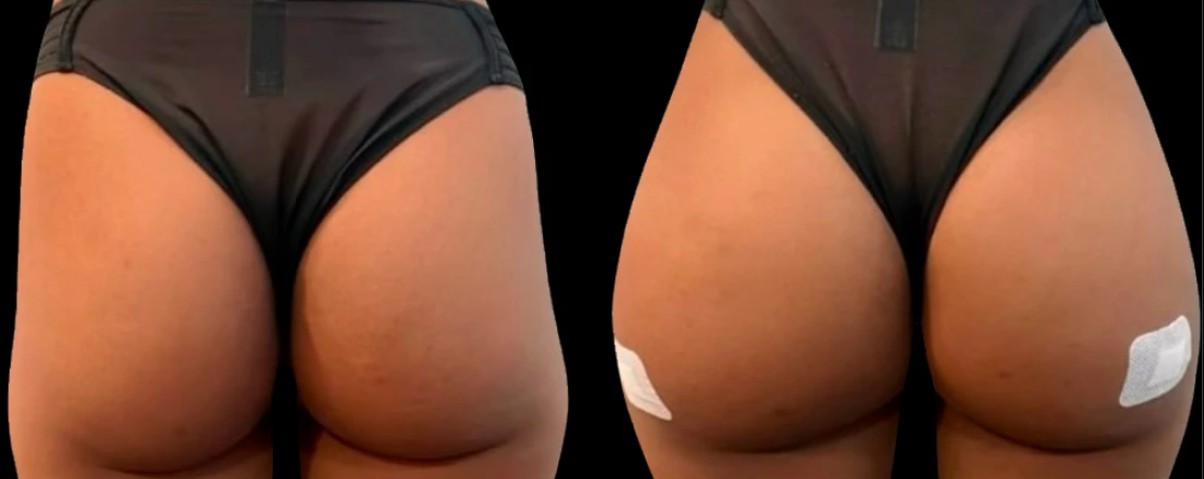
Clinical studies using HYAcorp body fillers document three measurable outcome categories: increased posterior projection, improved lateral contour through hip dips correction, and overall silhouette refinement. Patient satisfaction at 12 months is consistently high in published data, with projection improvements that are both measurable by standardized photography and meaningful to patients in their daily self-assessment. What the data does not show is dramatic volume transformation, and understanding that distinction is the starting point for honest expectation-setting.
Three Illustrative Candidacy Scenarios
Scenario A: The contour patient. A 34-year-old with natural gluteal volume but pronounced hip dips and a flat lateral profile. One session of MLF1 targeting the lateral hip produces a smooth, rounded silhouette with no recovery interruption to her work schedule. Results are visible immediately and settle to their final shape within two weeks. This is the highest-yield candidacy profile for HA.
Scenario B: The projection patient. A 29-year-old with moderate soft tissue coverage who wants measurable posterior projection but not a dramatic change. Two sessions of MLF2 spaced six months apart move her from flat to visibly rounded. Results are proportionate and natural for her frame, with maintenance at 18 months sustaining the outcome.
Scenario C: The volume-first patient. A 41-year-old with low body fat, minimal gluteal muscle, and significant volume goals. Injectable treatment cannot deliver what she wants at the volume she is envisioning. An honest candidacy assessment redirects her toward surgical consultation, sparing her the cost and disappointment of repeated non-surgical sessions chasing an unreachable result.
What “Natural-Looking Results” Actually Means in Clinical Terms
“Natural-looking” is not a style preference — it is a technical outcome determined by placement precision, volume calibration, and product-tissue compatibility. In clinical terms, natural results mean filler that is non-palpable to touch, contours that match the patient’s anatomical proportions, and projection that reads as inherent to the body rather than applied to it. Overfilling, incorrect plane placement, or using a product with inappropriate viscosity for the zone being treated are the most common technical reasons results look artificial rather than integrated.
How Many Sessions Are Typically Needed
Most patients reach their target outcome in one to two sessions. The first session establishes volume and corrects the primary concern. A second session, if needed, is typically scheduled six months later to refine asymmetries or add incremental projection. Patients with significant hip dips correction needs sometimes require a staged approach across three sessions, but this is the exception rather than the rule. A practitioner who recommends four or five sessions at your initial consultation is either managing very complex anatomy or over-engineering a treatment plan, and either possibility warrants a candid conversation about goals and expectations.
What Results Will Not Look Like: Setting an Honest Baseline
A hyaluronic BBL will not produce the volume of a surgical fat transfer, the dramatic silhouette transformation visible in heavily filtered before-and-after photography, or results that persist indefinitely without maintenance. It will not correct skin laxity, cellulite, or structural ptosis. These are not shortcomings — they are the natural parameters of an injectable procedure operating within its appropriate clinical scope. Patients who understand these boundaries before treatment consistently report higher satisfaction than those who discover them afterward.

Safety Profile, Side Effects, and the Reversibility Advantage
What the Clinical Evidence on HYAcorp Safety Shows
The published safety record for HYAcorp body fillers in gluteal augmentation is strong within its intended use population. Studies report no serious adverse events in appropriately screened candidates treated by trained practitioners using correct anatomical placement protocols. The most significant risk factor in the clinical literature is not the product but the placement: injections into vascular structures or at incorrect tissue depth carry complication risk regardless of which filler is used, which is why provider selection is as clinically important as product selection.
Common Side Effects: Timeline and Management
Expected side effects are local and temporary. Swelling is the most consistent response and typically peaks at 48-72 hours before resolving over the following week. Bruising occurs in a minority of patients and resolves within 7-10 days. Mild pressure discomfort at injection sites is normal for the first few days, particularly when sitting. These are predictable physiological responses to tissue infiltration, and they resolve without intervention in the large majority of cases.
Hyaluronic Acid Buttock Injections vs. Surgical BBL: Comparing Risk Profiles
The side effect profiles are not comparable in scale. Hyaluronic acid buttock injections carry local, transient side effects in the vast majority of patients. Surgical BBL carries systemic risks including anesthesia complications, infection, seroma formation, asymmetric fat survival, and the rare but serious risk of pulmonary fat embolism. The post-operative recovery period for surgical BBL involves six or more weeks of modified positioning, restricted sitting, and activity limitations that have meaningful professional and personal consequences. Choosing between these options is a risk-calibration decision based on your health history, recovery capacity, and tolerance for uncertainty — not simply a matter of desired outcome.
The Exit Strategy: Can HA Fillers Be Dissolved If Results Disappoint?
How Hyaluronidase Dissolution Works
Hyaluronidase is an enzyme that breaks down cross-linked HA by cleaving the molecular bonds that give the filler its structure. Injected directly into the treated area, it degrades the filler over 24-72 hours, returning the tissue to its pre-treatment baseline. The process is not instantaneous — patients typically observe progressive softening over one to three days — but the outcome is reliable. Multiple treatment sessions with hyaluronidase are occasionally needed for high-volume placements, but full dissolution is achievable.
When Dissolution Is Indicated vs. When Patience Is the Better Protocol
Dissolution is clinically indicated for vascular compromise, significant asymmetry, palpable irregularity that does not resolve with time, or patient dissatisfaction that persists beyond the six-week settling period. For patients who are simply adjusting to their new contour — which looks different standing, sitting, and in different clothing — a four-to-six-week observation period before considering dissolution is usually the more appropriate approach. Swelling distorts early results, and decisions made at two weeks often do not reflect what the settled outcome will look like at eight weeks.
Why Reversibility Is a Clinical Feature, Not a Marketing Promise
Reversibility matters because outcomes exist on a spectrum. Even technically correct procedures occasionally produce results that fall outside what a patient envisioned. The ability to dissolve and start again is not an admission that the procedure is risky — it is a design feature that aligns with how aesthetic preferences actually work: they are personal, contextual, and sometimes different from what a patient anticipated before experiencing the result on her own body. No other volumizing option for this area offers this correction pathway.
How Long Does Hyaluronic BBL Last, and How to Extend It Intelligently
The 12-24 Month Longevity Window: What Influences Where You Fall
Most patients see results lasting 12 to 24 months, but that range is driven by identifiable variables. Metabolic rate affects HA degradation, with higher-metabolism individuals typically breaking down filler more quickly. The volume placed matters, as larger depot volumes tend to maintain longevity slightly longer than minimal placements. Physical activity level plays a role as well, with high-impact athletes experiencing faster degradation due to greater mechanical load on the treated tissue. Understanding where you fall on these factors lets you plan maintenance timing realistically.
Aftercare Protocols That Directly Impact Filler Longevity
Aftercare is not ceremonial. Specific behaviors in the first two weeks after treatment directly influence how long results last.
Post-Treatment Positioning and Pressure Avoidance
Avoiding sustained pressure on the treated area for the first two weeks is the single most impactful aftercare instruction. Prolonged sitting compresses subdermal filler depots before they have fully integrated into surrounding tissue, which can cause displacement and uneven settling. Using a cushion that offloads pressure from the central gluteal area during unavoidable sitting periods is a practical solution for the first week.
Activity Restrictions and Their Rationale
High-impact activity — running, HIIT, heavy squats — should be avoided for two weeks. The rationale is mechanical: repetitive compressive and shearing forces disrupt filler integration before the product has stabilized in its placement plane. Light walking is acceptable within 24-48 hours. Resistance training that does not directly load the gluteal area can typically resume at one week. These restrictions protect the investment, not just the immediate recovery.
Hydration, Skincare Synergies, and Systemic Support
HA filler binds water as part of its volumizing mechanism, and systemic hydration supports this process. Well-hydrated patients often report that results look more natural and feel softer during the integration period. Topical treatments with retinoids or active acids in the gluteal area should be paused for one week post-treatment to avoid any surface disruption over injection sites.
Follow-Up Scheduling and the Case for Maintenance Treatments
A follow-up appointment at six to eight weeks allows your practitioner to assess settling, address any minor asymmetry, and document baseline photography for maintenance planning. The case for maintenance is straightforward: scheduling a top-up session before results fully dissipate — typically at 12 to 18 months depending on your individual longevity profile — maintains a continuous outcome rather than requiring a restart from baseline, which often requires more product and more sessions to restore.
Recovery Time for Hyaluronic Acid BBL Compared to Non-Surgical Alternatives

Recovery from a hyaluronic BBL is measured in days, not weeks. Most patients return to desk work and light daily activity within 24 to 48 hours. Sculptra carries a comparable recovery profile, with similar post-treatment swelling and bruising timelines. The meaningful comparison is with surgical BBL, where recovery extends six or more weeks and includes strict positioning protocols, activity restrictions, and the physical demands of surgical healing. For the patient whose professional and personal schedule cannot absorb that kind of interruption, the recovery differential alone makes non-surgical gluteal augmentation the only realistic option.
Combination Approaches: When Hyaluronic BBL Performs Best as Part of a Layered Protocol
Why Multi-Dimensional Outcomes Require Multi-Modality Thinking
A single procedure addresses a single dimension of aesthetic concern. The patients who achieve the most visually complete results are rarely those who treated one variable in isolation — they are the ones whose protocols addressed volume, tissue quality, and surface texture as the distinct but interconnected problems they actually are. A hyaluronic BBL can add projection and correct hip dips with precision, but it does not stimulate collagen, tighten skin, or smooth surface irregularities. Recognizing what it does not do is the starting point for building a protocol that does everything you need.
HA and Sculptra Layering: Sequential Collagen Stimulation With Immediate Volume
One of the most clinically productive combinations pairs Sculptra first, followed by a hyaluronic BBL several months later. The logic is sequential: Sculptra improves tissue architecture over three to six months, building a collagen matrix that creates a better substrate for filler placement. When HA is then introduced into tissue that has already been remodeled through collagen stimulation, the filler integrates more naturally, sits more evenly, and benefits from improved surrounding tissue quality.
This sequencing is particularly relevant for patients with mild laxity who also want visible projection. Sculptra alone cannot deliver the projection they want. HA alone would sit in tissue that needs structural improvement first. Used together in the right order, the two products address different layers of the same outcome.
Pairing HA BBL With Skin Tightening Modalities
Volume without surface definition produces a softer, less sculpted result. Radiofrequency and ultrasound-based skin tightening modalities address the layer that injectable filler cannot reach: dermal laxity and tissue firmness. Performed before or after a hyaluronic BBL depending on the degree of laxity present, these treatments improve skin elasticity and contour definition in a way that makes non-surgical buttock augmentation results look more refined rather than simply larger.
The general recommendation is to perform skin tightening before filler placement, allowing tissue quality to improve and giving the practitioner a clearer picture of the structural canvas they are working with. In some protocols, a maintenance tightening session is scheduled at the same time as a follow-up HA assessment, maintaining both dimensions of the outcome simultaneously.
Cellulite Reduction as a Complementary Surface-Level Refinement
Cellulite is a structural problem at the level of fibrous septae tethering the dermis downward, and no volumizing injectable addresses it directly. Patients who add projection via HA filler sometimes notice that surface texture becomes more visible with the increased volume behind it, which is why addressing cellulite as part of a combination protocol — rather than as an afterthought — produces more cohesive final results. Energy-based or mechanical treatments targeting the subdermal fibrous bands work independently of filler and can be incorporated before treatment or at a separate appointment after HA has fully settled.
How MEDSPA MD Structures Combination Protocols for Individual Candidacy Profiles
At MEDSPA MD, combination protocols are built backward from a patient’s specific goals rather than forward from available treatments. The candidacy assessment identifies which dimension of the aesthetic concern is primary, which is secondary, and which requires a different modality entirely. A patient with good skin quality and defined hip dips needs a different protocol than one with diffuse laxity and a moderate volume deficit. Layering treatments without this individual mapping produces an expensive outcome that still falls short of what a targeted protocol would achieve.
Hyaluronic BBL Cost vs. Surgical BBL: Evaluating the Investment Across Your Timeline
How Much Does a Hyaluronic Acid BBL Cost Relative to Surgical BBL?
A hyaluronic BBL session typically ranges from $3,000 to $6,000 depending on the volume of product used and the provider’s market. A full Sculptra protocol for gluteal augmentation generally falls between $4,000 and $8,000, factoring in the multiple sessions required. Surgical BBL, when you account for surgeon fees, facility costs, and anesthesia, typically starts at $8,000 and extends to $15,000 or more in high-cost markets or for complex cases. These are entry-level figures, and actual pricing varies by geography, provider experience, and treatment complexity.
The True Cost Comparison: Single Procedure vs. Maintenance Cycles vs. Surgical Recovery
The number that matters most is not the upfront procedure cost — it is the total investment over a realistic time horizon. A surgical BBL’s permanence means the surgical cost is a one-time figure spread across decades of result. A hyaluronic BBL requires maintenance every 12 to 24 months, and three to five years of maintenance sessions can match or exceed the surgical cost without producing a permanent outcome.
What the procedure cost calculation often omits, however, is the real cost of surgical recovery: time away from work, post-operative care supplies, compression garments, follow-up appointments, and the indirect professional and personal costs of six weeks of restricted activity. For a patient whose time has direct income value, that recovery cost is not negligible. For a patient who cannot absorb that interruption regardless of cost, the comparison becomes less about dollars and more about feasibility.
Cost-Per-Year-of-Result: A More Useful Metric
Dividing the total procedure cost by the expected years of maintained result produces a more honest comparison than upfront price alone. A hyaluronic BBL at $4,500 lasting 18 months costs approximately $3,000 per year of outcome. A surgical BBL at $12,000 lasting 15 years costs approximately $800 per year. Sculptra at $6,000 lasting two to three years costs $2,000 to $3,000 per year. Over a short horizon, the differences are modest. Over a decade, the surgical option’s cost-per-year advantage becomes substantial — provided you are a surgical candidate and can accept the recovery and risk profile that comes with it.
The cost-per-year framework is most useful for patients genuinely weighing non-surgical maintenance cycles against a surgical option. For patients who are not surgical candidates, the relevant question becomes which non-surgical path delivers the best return on their specific goals.
Why the Most Expensive Mistake Is the Procedure That Doesn’t Match Your Goals
The highest-cost outcome in aesthetic medicine is not the most expensive procedure — it is the wrong procedure. A patient who pursues repeated hyaluronic BBL sessions chasing volume that only surgery can provide has spent more than the surgical cost by the time she arrives at the outcome she needed from the start. A patient who undergoes surgical BBL and spends six weeks in recovery only to find the permanence and scale of change more than she wanted has paid a price no refund policy covers.
Cost is only meaningful in relation to outcome. The procedure that matches your candidacy profile, your timeline, and your aesthetic goal will always be the most cost-efficient option, regardless of its sticker price.
Quick-Pick Recommendation
Not sure which path fits? Use this as your starting filter:
- You want visible results within weeks, minimal downtime, and a reversible option: hyaluronic BBL is your starting point.
- You want gradual, diffuse improvement over six to twelve months and aren’t concerned with measurable projection: consider Sculptra.
- You want significant, permanent volume and have adequate donor fat and recovery capacity: surgical BBL is the honest recommendation.
- You have multiple concerns spanning volume, laxity, and surface texture: a combination protocol assessed at consultation will outperform any single procedure.
Conclusion: Your Silhouette, Your Decision — and What an Expert Assessment Changes
The Central Argument, Restated Through a Clinical Lens
Each procedure covered in this guide is clinically sound for the right patient. Hyaluronic BBL is not a lesser version of surgical BBL — it is a different tool with a different mechanism, a different risk profile, and a different population of patients for whom it produces genuinely excellent results. The clinical error is not choosing any of them. The clinical error is choosing the one that doesn’t match your body, your timeline, and your actual goal.
Patients who achieve lasting satisfaction from aesthetic procedures are, almost without exception, patients whose treatment was selected based on an honest candidacy assessment rather than a trending option or a compelling before-and-after photo.
Why Personalized Candidacy Assessment Is the Differentiating Variable in Outcomes
The information in this guide gives you a strong framework for self-assessment, but a consultation provides what no article can: a practitioner’s direct evaluation of your tissue quality, volume baseline, skin laxity, and anatomical proportions mapped against your specific aesthetic goals. That evaluation changes the recommendation in ways that written frameworks cannot fully anticipate.
Patients who arrive at consultations with a clear understanding of what each procedure does — and what they are prioritizing — receive more productive conversations. The discussion shifts from basic education to nuanced matching, and the resulting treatment plan reflects your individual situation rather than a default protocol.
Your Next Step: Booking a Personalized Consultation at MEDSPA MD
A guide this detailed can narrow your options considerably. But confirming which path is genuinely right for your body requires a practitioner who can assess what no article can see. At MEDSPA MD, candidacy consultations are structured to do exactly that: evaluate your individual anatomy, clarify your goals, and recommend the protocol — or combination of protocols — that will actually deliver them. If you recognize yourself in the hyaluronic BBL candidacy profile, the next productive step is a conversation with someone who can confirm it with clinical precision.

Frequently Asked Questions
Yes, within a well-defined scope. Hyaluronic acid is an effective option for patients seeking moderate gluteal volume augmentation, hip dips correction, or silhouette refinement. It does not replicate the volume capacity of surgical fat transfer, but for the right candidate it delivers reliable, natural-looking results with a strong safety profile and the added advantage of full reversibility.
Most patients maintain results for 12 to 24 months. Where you fall within that range depends on your metabolic rate, physical activity level, and the volume of product placed. Higher-metabolism individuals and those with high-impact fitness routines typically experience faster degradation. Scheduling a maintenance session before results fully dissipate — rather than waiting until volume is gone — helps preserve your outcome more efficiently.
Expected side effects are local and temporary. Swelling is the most common response, typically peaking at 48-72 hours and resolving within a week. Bruising occurs in a minority of patients and clears within 7-10 days. Mild pressure discomfort at injection sites is normal for the first few days. These are predictable physiological responses to treatment and resolve without intervention in the large majority of cases.
Sessions typically range from $3,000 to $6,000 depending on the volume of product used and the provider’s location and experience. Rather than comparing upfront costs alone, a cost-per-year-of-result calculation offers a more useful perspective when weighing this option against Sculptra protocols or surgical BBL over a realistic time horizon.
Yes. Hyaluronidase reliably breaks down cross-linked HA over 24 to 72 hours, returning tissue to its pre-treatment baseline. This reversibility is one of the most clinically significant advantages of the hyaluronic BBL — it provides a genuine correction pathway that neither Sculptra nor surgical BBL can offer, making it a particularly well-suited first option for patients who have not previously had volumizing treatment in this area.
The two carry fundamentally different risk profiles. Hyaluronic acid buttock injections are a non-surgical procedure with local, transient side effects in the vast majority of patients. Surgical BBL involves general anesthesia, a multi-week recovery, and systemic risks including infection, seroma formation, and — in rare cases — pulmonary fat embolism. For patients who are not surgical candidates or cannot accommodate extended downtime, non-surgical gluteal augmentation with HA offers a meaningfully safer alternative without compromising on clinical quality when the candidacy is appropriate.