
Table of Contents
- The Shift Away from Surgical BBL
- Sculptra, Radiesse, and Bellafill: Which Injectable Is Right for Your Body and Goals
- Injectable Comparison: Sculptra, Radiesse, and Bellafill for Buttock Augmentation
- How Many Sessions Will You Need and When Will You See Results
- How Many Sessions Are Needed to See Results
- What Non-Surgical Buttock Augmentation Actually Costs: A Transparent Regional Breakdown
- Who Is and Who Is Not a Good Candidate for Buttock Injections
- Clear Contraindications: When Non-Surgical Injections Are Not the Right Path
- Risks, Side Effects, and What Honest Recovery Actually Looks Like
- Why a Multi-Modality Approach Outperforms Any Single Injectable Choice
- Your Transparent Roadmap to Booking a Liquid BBL Consultation
- Frequently Asked Questions
The Shift Away from Surgical BBL
Surgical Brazilian Butt Lifts carry a mortality rate higher than nearly any other elective cosmetic procedure, a fact that has reshaped how both patients and providers approach buttock augmentation. The American Society of Plastic Surgeons and multiple international safety bodies have issued revised guidelines, and the conversation has shifted accordingly. Patients who were once willing to accept significant surgical risk are now actively seeking alternatives that deliver meaningful results without general anesthesia, liposuction harvest sites, or weeks of restricted sitting.
The demand is real and growing, but the shift is not purely about fear. Many women simply do not want the recovery that surgery demands. A two-to-six-week period of avoiding sitting, sleeping face-down, and pausing professional and personal life is a cost that does not fit the reality of how most women actually live.
Defining Non-Surgical Buttock Injections and the Liquid BBL Concept
Non-surgical buttock injections use FDA-cleared injectable compounds to add volume, stimulate the body’s own collagen production, or both, without incisions or implants. The term “Liquid BBL” describes a treatment approach rather than a specific product. It refers to achieving the lift, shape, and projection associated with a surgical BBL through strategic injectable placement, contouring technique, and, often, a combination of products.
The result is not identical to surgery, and any provider who suggests otherwise is not being honest with you. What a well-executed Liquid BBL can deliver is a perceptible improvement in shape, projection, and skin quality that develops gradually and looks natural precisely because it works with your anatomy rather than altering it mechanically.
How Collagen Stimulation Works: The Science Behind Sculptra and Poly-L-Lactic Acid
Sculptra’s active ingredient, poly-L-lactic acid (PLLA), is a synthetic but biocompatible polymer that has been used in dissolvable sutures for decades. When injected into the subdermal tissue of the buttocks, PLLA microparticles trigger a controlled inflammatory response. The body encapsulates each particle with new collagen fibers, and as the PLLA gradually dissolves over several months, the collagen matrix it stimulated remains.
This is a fundamentally different mechanism than traditional filler. You are not adding a foreign substance that persists indefinitely. You are prompting your own tissue to build structure. The collagen produced is your body’s own, which explains both the natural appearance of results and the gradual timeline required to see them.
What Non-Surgical Buttock Injections Can and Cannot Achieve

A Liquid BBL performed by a skilled injector can produce visible improvements in projection, upper pole fullness, symmetry, and skin surface quality. Patients with mild-to-moderate volume loss, flat contour, or early ptosis tend to respond well. The procedure can also improve the appearance of cellulite and skin laxity in the treated area, depending on the product used and the technique applied.
What injectable augmentation cannot do is replicate the dramatic size increase achievable with fat transfer or implants, correct severe ptosis requiring surgical tissue repositioning, or serve patients who need structural changes that injectables cannot safely provide. This limitation does not disqualify the treatment. It is an honest boundary that any provider worth consulting will tell you upfront.
Sculptra, Radiesse, and Bellafill: Which Injectable Is Right for Your Body and Goals
Understanding the Core Differences Between Collagen Stimulators and Volumizing Fillers
The three injectables most commonly used for non-surgical buttock augmentation work through different mechanisms, which means they suit different goals, timelines, and body types. The choice is not simply about which product is “best.” It is about which mechanism aligns with what you are trying to achieve, how quickly you want to see results, and how long you need them to last.
Sculptra Aesthetic: The Gradual Rebuilder
Sculptra is the most widely used injectable for Liquid BBL, and for good reason. Its collagen-stimulating mechanism produces results that improve progressively over two to six months, peak around month six, and can last two or more years with appropriate maintenance. Patients who respond best are those who can commit to a multi-session protocol, typically three to four vials per session across two to three sessions, are not seeking immediate visible change, and want an outcome that looks indistinguishable from natural anatomy.
Radiesse: Immediate Volume with Collagen-Stimulating Properties
Radiesse is a calcium hydroxylapatite (CaHA) filler that provides immediate visible volume while simultaneously stimulating collagen. Patients see a result on the day of treatment, which makes it useful for those who want an early indicator of change or who need results before a specific event. Its longevity is typically 12 to 18 months in the buttocks, somewhat shorter than Sculptra. Hyperdiluted Radiesse is increasingly used in combination protocols, particularly for skin quality improvement across the posterior thigh and buttock surface.
Bellafill: Long-Duration Volume and Structural Support
Bellafill is a polymethylmethacrylate (PMMA) microsphere filler suspended in bovine collagen gel. Unlike the first two options, PMMA microspheres are not absorbed by the body, which gives Bellafill a significantly longer duration, with some results persisting five years or more. This longevity makes it a strong option for patients who want reduced maintenance frequency. It does require a skin test 28 days before treatment to rule out bovine collagen sensitivity, and the permanence of the PMMA component demands exceptional injector precision.
Choosing the Right Injectable for Your Body Type
Body type meaningfully influences which injectable produces the most proportionate outcome. Patients with a lean frame and limited subcutaneous tissue tend to do well with Sculptra’s gradual collagen-build approach because it integrates with existing tissue rather than adding bulk that may feel or appear unnatural in the absence of adequate soft tissue coverage. Those with moderate existing volume who want shape refinement and immediate projection feedback often find Radiesse a better fit. Patients with adequate soft tissue depth who want long-duration structural enhancement and minimal ongoing maintenance are the strongest candidates for Bellafill, provided they have completed allergy testing.
No single injectable is universally superior. The most thoughtful providers evaluate your existing anatomy, skin quality, desired outcome, and timeline before recommending a product.
Injectable Comparison: Sculptra, Radiesse, and Bellafill for Buttock Augmentation
The table below summarizes the key clinical differences across the decision factors that matter most to the busy, outcomes-focused patient.
| Decision Factor | Sculptra (PLLA) | Radiesse (CaHA) | Bellafill (PMMA) |
|---|---|---|---|
| Mechanism | Stimulates collagen production with no immediate filler volume | Immediate volume plus collagen stimulation | Immediate volume via PMMA microspheres with long-term structural support |
| Onset of visible results | Gradual — noticeable improvement at 2 to 3 months, peak at 6 months | Immediate volume day of treatment, collagen benefit builds over weeks | Immediate volume, full integration over 1 to 3 months |
| Longevity | 2 or more years with maintenance sessions | 12 to 18 months | 5 or more years (PMMA is non-absorbable) |
| Ideal candidate | Patient who wants natural, progressive results and tolerates a multi-month timeline with a lean to average frame | Patient who wants earlier visible change with combined shape and skin quality goals | Patient with adequate tissue depth who wants long-duration results and low maintenance frequency |
| Typical session count | 2 to 3 sessions spaced 4 to 6 weeks apart | 1 to 2 sessions depending on volume goals | 1 to 2 sessions, allergy test required 28 days prior |
| Relative cost tier | Mid to high per vial, total investment spread across sessions | Mid per session with fewer sessions needed | Higher upfront investment, lower long-term cost given longevity |
This comparison reflects general clinical patterns, not absolute rules. A practitioner evaluating your anatomy in person will refine these recommendations considerably. Patients with complex goals, such as asymmetry correction alongside overall projection increase, often benefit from a combination approach using two products in a coordinated protocol.
Non-Surgical BBL vs. Surgical BBL: Understanding the Real Distinction
There is no single best injectable for all patients, and that answer is not a hedge. It is the most accurate guidance available. Sculptra earns its position as the most commonly recommended option for Liquid BBL because its collagen-stimulating mechanism produces results that are anatomically integrated and long-lasting. The right answer for your body may be a different product, a different combination, or a phased protocol that adjusts as your results develop.
The more meaningful distinction is between the injectable approach and surgical BBL. Surgery using fat transfer can add substantial volume, reshape significant structural contour issues, and produce results in a single procedure. Non-surgical injections work within a narrower volume range, require multiple sessions, and produce more subtle, progressive change. What the injectable approach offers in return is no general anesthesia, no recovery period that removes you from your life, no donor site incisions, and a significantly lower risk profile.
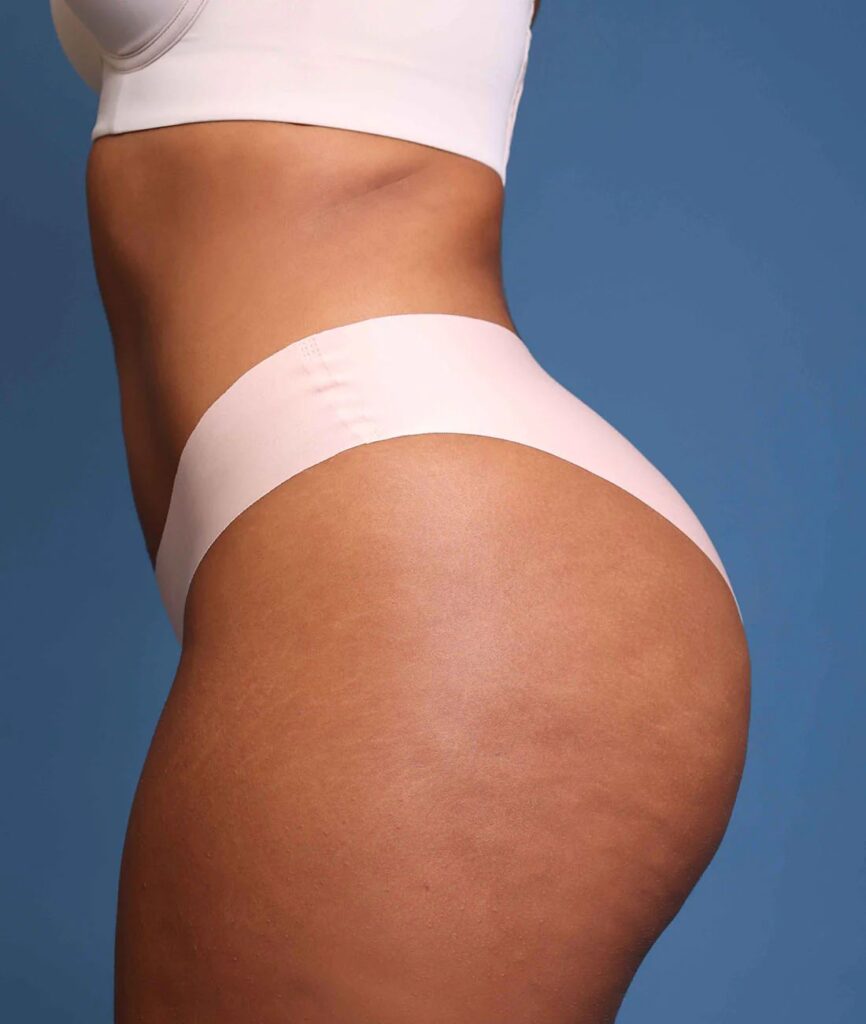
For patients whose goals fall within what injectables can realistically achieve, the trade-off is favorable. For patients whose goals require what only surgery can deliver, honesty about that distinction is the most valuable thing a provider can offer.
How Many Sessions Will You Need and When Will You See Results
Why a Single Session Is Rarely Sufficient
Most patients searching for non surgical buttock injections near me find pricing pages that quote a single-session cost without explaining that one session rarely completes the treatment. For Sculptra, the collagen-building mechanism requires accumulated stimulus. Each session adds a new wave of PLLA microparticles, which means session two builds on the collagen response initiated in session one. A single visit produces some improvement, but the full architectural change requires a planned series.
This is not a sales strategy. It is how the biology works. Patients who understand this upfront make better decisions about timing, budgeting, and whether the treatment fits their life at this moment.
A Session-by-Session Timeline for the Busy Professional
The timeline below reflects a standard Sculptra-based Liquid BBL protocol, which is the most common framework. Radiesse and Bellafill timelines differ modestly, but the overall arc applies broadly.
Week One: Initial Settling
You will likely see some temporary swelling immediately after your first session, which can create the impression of early results. This subsides within five to seven days as the water used to reconstitute Sculptra absorbs. By day seven, that initial volume has resolved. What you have at this point is not nothing — the PLLA microparticles are in place and the collagen response has begun — but there is no visible change yet. Expect some bruising and mild tenderness at injection sites.
Month One: Early Collagen Response
By the four-week mark, some patients notice the earliest signs of improved firmness or slight projection. Most do not, and that is entirely normal. The collagen-building process is occurring below the surface, and the changes at this stage are measurable in tissue quality rather than visible shape. Your second session is typically scheduled around this point, layering a second collagen stimulus onto the developing response from session one.
Month Three: Visible Lift and Volume Emergence
This is when most patients first see what the treatment is delivering. The combined collagen response from sessions one and two is producing structural change. Projection is more defined, upper pole fullness is emerging, and patients who had skin texture concerns in the treated area often notice improvement. If a third session is indicated, it is commonly placed here to reinforce peak-result volume.
Month Six and Beyond: Peak Results and Longevity
Full results from a Sculptra-based protocol are typically visible by month five or six. This is the window in which before-and-after documentation is taken, and it is the point at which you can accurately evaluate whether a touch-up session is warranted. With appropriate maintenance, results persist two or more years. The collagen matrix your body built does not disappear overnight — it gradually remodels, and a single maintenance session can extend the result considerably.
How Many Sessions Are Needed to See Results
The clinical standard for Sculptra buttock augmentation is two to three sessions spaced four to six weeks apart. Patients with a lean frame and limited existing soft tissue may need three sessions to achieve the volume and collagen density that produces a visible outcome. Patients with moderate existing volume seeking shape refinement may see satisfying results after two. Radiesse protocols typically require one to two sessions, with some patients completing treatment in a single visit depending on volume goals. Bellafill requires one to two sessions plus a pre-treatment allergy test.
The honest answer is that most patients need a minimum of two sessions to see results they consider worth the investment.
How Long Results Last and What the Maintenance Schedule Looks Like
Sculptra results in the buttocks last two to three years for most patients before visible diminishment occurs. A single maintenance session at the two-year mark can reset the longevity clock without requiring the full original protocol. Radiesse results typically require refreshing at 12 to 18 months. Bellafill’s PMMA component persists indefinitely, though the collagen gel carrier absorbs over time, meaning touch-up treatment may be needed at the three-to-five-year mark depending on the original volume placed.
Plan for maintenance as part of your total treatment relationship with this procedure, not as an unanticipated additional cost.
Scheduling a Multi-Session Plan Around a Demanding Calendar
A full Sculptra protocol runs approximately eight to twelve weeks from session one to session three. Each appointment takes 45 to 90 minutes. Post-treatment, most patients return to desk work the same day or the next. Physical activity involving direct pressure to the treatment area should be limited for 24 to 48 hours.
The practical approach is to book all sessions at your first consultation so you control the calendar. Spacing sessions five weeks apart rather than four gives your schedule flexibility without meaningfully disrupting the collagen-response sequence. If travel or a demanding work period falls in your treatment window, sessions can typically be delayed by one to two weeks without compromising outcomes. What you want to avoid is extending the gap beyond eight weeks between sessions, which allows the early collagen response to plateau before the next stimulus is added.

What Non-Surgical Buttock Augmentation Actually Costs: A Transparent Regional Breakdown
Why Single-Session Pricing Is Misleading
A single vial of Sculptra costs between $800 and $1,000 at most reputable providers. A standard session for buttock augmentation uses four to eight vials. A three-session protocol at four vials per session produces a total vial count of 12, which translates to a total product cost of $9,600 to $12,000 before facility and injector fees. This is the number most clinic websites do not prominently display.
Think in total protocol cost, not session cost. A provider quoting $800 per vial and a provider quoting $1,000 per vial are not necessarily meaningfully different in total investment once volume recommendations are factored in. What matters is the total number of vials recommended, the rationale behind that recommendation, and whether the protocol is calibrated to your anatomy or to a standard template.
Regional Pricing Context: NYC, Brooklyn, Miami, and NJ
Geographic market significantly affects pricing. In Manhattan and Brooklyn, Sculptra protocols for buttock augmentation typically range from $4,500 to $8,000 per session at established medspas, with total protocol costs commonly landing between $10,000 and $18,000. Miami pricing runs slightly lower on average, with reputable providers ranging from $3,500 to $6,500 per session. New Jersey markets adjacent to NYC tend to reflect similar ranges to Brooklyn, with some variation depending on practice profile.
Radiesse buttock augmentation protocols, which typically require fewer sessions, run $3,000 to $6,000 total in these markets. Bellafill, given its longevity, can present a higher upfront cost — typically $5,000 to $10,000 for a complete treatment — but lower long-term maintenance costs than Sculptra.
These figures reflect established, credentialed providers. Pricing significantly below these ranges warrants careful scrutiny of the provider’s training and the authenticity of products used.
The True Cost of Time: Non-Surgical vs. Surgical Recovery
Surgical BBL requires two to six weeks of restricted activity, including avoiding sitting on the buttocks, sleeping in specific positions, and limiting exercise. Many patients require two to four weeks away from desk work depending on their job requirements, plus the cost of compression garments, post-operative massage, and follow-up visits.
Non-surgical buttock injections involve no procedure-related work absence for most patients. The 48-hour activity limitation is the primary constraint. Multiply that by three sessions and you have six days of modest activity restriction spread across a three-month window, compared to a compressed four-to-six-week surgical recovery. For a professional who cannot absorb a multi-week absence, this difference is not trivial.
Framing Cost Against Long-Term Value
A $12,000 Sculptra protocol lasting three years costs approximately $4,000 per year to maintain the result. A surgical BBL, priced between $8,000 and $15,000 depending on market and surgeon, is a one-time cost, but revision rates, post-operative complications, and fat reabsorption can add costs that reduce the apparent value of the single-procedure price.
Neither approach is categorically more economical. The relevant question is which investment produces the outcome you actually want, with the risk profile you can accept, on a timeline that fits your life.
Who Is and Who Is Not a Good Candidate for Buttock Injections
The Ideal Candidate Profile
The strongest candidates for non-surgical buttock augmentation are patients who want a meaningful but proportionate improvement in shape and projection, not a dramatic size increase. They typically have mild to moderate volume deficit, flat contour, or early ptosis rather than severe structural concerns. They understand that results develop gradually and are prepared for a multi-session commitment. And they are in good general health, are not pregnant or breastfeeding, and hold realistic expectations about the ceiling of what injectables can achieve.
Lifestyle alignment matters as much as body type. Patients who can schedule three appointments over three months, observe a 48-hour activity limitation after each session, and follow post-treatment massage protocols consistently tend to see significantly better outcomes than those who treat sessions as isolated events.

Petite Frames and Low BMI: What to Know
A petite frame does not automatically disqualify a patient, but it does change the clinical calculus. Patients with very low BMI and minimal subcutaneous tissue present two challenges: the volume of product needed to produce a visible result is higher relative to body mass, and the risk of product feeling or appearing unnatural is elevated when there is limited soft tissue to integrate with.
For lean patients, Sculptra’s collagen-stimulating mechanism is typically better suited than direct volumizing fillers, because the tissue it builds is derived from the patient’s own biology rather than added as a discrete bolus. A conservative, phased approach allows the injector to evaluate integration at each session before adding more product. Petite patients often achieve natural-looking results but should expect a longer protocol and more gradual progression than patients with moderate existing soft tissue.
Clear Contraindications: When Non-Surgical Injections Are Not the Right Path
Active Skin Conditions, Infections, and Autoimmune Considerations
Any active infection, open wound, or inflammatory skin condition in the treatment area is a contraindication. Injecting through compromised skin carries a risk of introducing bacteria into deeper tissue and must be postponed until the condition resolves. Patients with autoimmune conditions affecting wound healing or collagen metabolism should discuss their specific diagnosis with a provider before proceeding. Immunosuppressive medications may also affect the collagen response that underpins Sculptra’s mechanism.
Unrealistic Expectations and the Limits of Non-Surgical Volume Enhancement
Patients seeking multiple cup sizes of increase, dramatic structural reshaping, or results equivalent to a full surgical fat transfer are not well-served by non-surgical injections regardless of their physical eligibility. This is not a failure of the treatment. It is a mismatch between the tool and the goal, and a good provider identifies that mismatch at consultation and says so directly.
When Surgical Options Deserve an Honest Conversation
Patients with significant skin laxity, pronounced ptosis, or volume goals that require substantial structural change are better candidates for a surgical consultation than for injectable augmentation. Referring a patient to a surgical colleague when surgery is the more appropriate path is a mark of clinical integrity. If a provider evaluates your goals and does not raise the question of whether surgery might serve you better, that is worth noticing.
Risks, Side Effects, and What Honest Recovery Actually Looks Like
Are Non-Surgical Buttock Injections Safe
Non-surgical buttock injections are substantially safer than surgical BBL, but “non-surgical” does not mean risk-free. Sculptra, Radiesse, and Bellafill each have well-documented safety profiles when used by trained providers operating in appropriate clinical settings. The FDA-cleared status of these products reflects that evidence. What that designation does not account for is the skill differential between providers, and in injectable medicine, that variable carries significant weight.
The honest answer is that yes, the treatment is safe when performed correctly. The qualifications around “correctly” are where due diligence becomes your responsibility as a patient.
Common Side Effects: Bruising, Swelling, and Temporary Lumpiness
Most patients experience some combination of bruising, swelling, and tenderness at injection sites in the days following treatment. These are expected responses to needle placement and product introduction in the subdermal tissue, not signs of a problem. Swelling typically peaks at 48 hours and resolves within five to seven days. Bruising follows its own timeline depending on individual factors, typically seven to fourteen days.
Temporary lumpiness, or nodule formation, is the side effect that most surprises first-time patients. With Sculptra in particular, small palpable nodules can form as the body’s fibrous response encapsulates PLLA particles unevenly. The mitigation protocol — vigorous massage of the treatment area five times per day for five days following each session — exists specifically to prevent this. Patients who follow the massage protocol consistently have meaningfully lower nodule rates than those who skip it.
Rare but Serious Complications and the Role of Provider Expertise
Vascular complications are the category that warrants the most careful attention. Inadvertent injection into a blood vessel can cause tissue necrosis or, in extreme cases, embolic events. The buttocks contain a vascular anatomy that requires precise knowledge to navigate safely, and the risk is not theoretical. It is documented in clinical literature and is one reason this procedure should never be performed outside a clinical setting by an unqualified injector.
Granuloma formation is another rare but real complication, particularly with longer-duration products like Bellafill. Granulomas are immune-mediated reactions to filler material that can present months or years after treatment and require medical management.
Both categories of serious complications are meaningfully less likely when the injector has formal training in injectable anatomy, understands the depth planes specific to gluteal tissue, and works in a facility with emergency protocols in place. Provider selection is not a secondary consideration. It is the primary risk-management strategy available to you.
What to Realistically Expect in the Days and Weeks After Treatment
Days one through three typically involve the most discomfort: tenderness when sitting, visible swelling, and possible bruising. Most patients return to desk work within 24 hours. Days four through seven, swelling subsides and the treatment area begins to feel more normal. The massage protocol is active throughout this entire window.
By week two, most external signs of treatment are gone. Patients often describe this period as anticlimactic — the swelling resolved, but visible results have not yet arrived. This is the phase where managing expectations matters most. The collagen response is occurring below the surface on a timeline the patient cannot see or feel, but it is progressing precisely as intended.
Why Provider Credentials Are the Most Important Variable in Your Safety Equation
When patients search for non surgical buttock injections near me, the results surface clinics across a wide range of training backgrounds, from board-certified plastic surgeons and dermatologists to practitioners with minimal aesthetic training. The product used is the same. The anatomy it enters is the same. What differs is the injector’s depth of knowledge about vascular anatomy, tissue planes, product behavior, and complication management.
Ask every prospective provider three direct questions before booking: What is your specific training in injectable gluteal augmentation? How do you manage a vascular complication if one occurs? How many Liquid BBL procedures have you performed? The quality and specificity of those answers tells you more than any before-and-after gallery.

Why a Multi-Modality Approach Outperforms Any Single Injectable Choice
The Limitation of Single-Filler Clinics
A clinic that offers one injectable product and applies it uniformly across patient profiles is optimizing for operational simplicity, not patient outcomes. The buttocks are a complex aesthetic unit involving projection, contour, skin quality, and proportion relative to the waist and thighs. No single injectable addresses all of those variables equally well. Patients who receive a treatment plan that looks identical to the previous patient’s, without a thorough individual assessment, should ask why.
The better outcomes consistently come from providers who assess each dimension of a patient’s anatomy separately and select tools accordingly.
MEDSPA MD Group’s Liquid BBL Methodology: Combining Sculptra with Complementary Technologies
MEDSPA MD Group’s approach to Liquid BBL begins with Sculptra as the structural foundation for collagen-building and volume, but extends beyond filler placement into a coordinated protocol that addresses the surrounding anatomy. Where skin laxity accompanies volume deficit, hyperdiluted Radiesse can be introduced to improve surface quality across the posterior thigh and lower buttock. Where projection goals require both collagen scaffolding and immediate volume feedback, a combined Sculptra and Radiesse protocol delivers both timelines within the same treatment arc.
The starting point is always the patient’s specific anatomy and outcome goals, not a preset formula.
How Endolift Integrates with Injectable Augmentation for Proportionate Contouring
Endolift is a minimally invasive laser-based technology that delivers energy through a micro-optic fiber inserted beneath the skin surface. It stimulates collagen contraction and tissue retraction, producing a lifting effect that complements injectable augmentation without additional product volume.
In a multi-modality protocol, Endolift addresses skin laxity and contour definition that injectables alone cannot fully resolve, particularly at the lateral buttock and posterior thigh junction, where lift rather than volume is the primary need. Integrating Endolift into a Liquid BBL plan allows the injectable component to focus on projection and fullness while the laser component addresses the contour shaping that completes a proportionate result.
The Role of Personalized Treatment Planning in Achieving Natural-Looking Results
The difference between a result that looks natural and one that looks treated is almost never about which product was used. It is about whether the treatment plan accounted for the patient’s actual anatomy — existing projection, skin thickness, hip-to-waist ratio, degree of ptosis — rather than targeting a generic aesthetic template.
Personalized planning also means sequencing matters. Introducing volume before addressing laxity, or adding projection without accounting for lateral contour, produces results that read as artificial rather than natural. The providers who consistently achieve natural-looking outcomes are those who think architecturally, considering what the whole posterior looks like at the end of a protocol rather than optimizing each injection in isolation.
A Multi-Modality Treatment Plan in Practice
A patient presents with moderate projection deficit, mild skin laxity across the lower buttock and posterior thigh, and a goal of natural-looking fullness that photographs well without appearing augmented. A single-filler approach would place Sculptra for volume and call it complete.
A multi-modality protocol at MEDSPA MD Group structures the treatment differently. Session one introduces Sculptra across three projection zones with hyperdiluted Radiesse applied to the posterior thigh and lower buttock surface for skin quality improvement. At month two, session two reinforces the Sculptra collagen response. At month three, an Endolift treatment addresses lateral contour lift and the remaining laxity that injectable volume cannot fully correct. By month six, the result is a cohesive improvement in shape, projection, skin quality, and contour that reflects the patient’s natural anatomy at its best — not a visible augmentation.
That distinction, anatomy at its best versus visible augmentation, is what thoughtful multi-modality planning consistently delivers.
Matching Your Goal to the Right Approach
- Moderate volume increase: A Sculptra protocol over two to three sessions produces proportionate projection that integrates naturally with existing anatomy. Best for patients with adequate soft tissue depth and a flexible three-month timeline.
- Lift with skin quality improvement: Sculptra combined with hyperdiluted Radiesse, plus Endolift for tissue retraction, addresses both volume and surface laxity for patients whose goals include improved contour definition alongside fullness.
- Maximum projection: A phased Sculptra and Radiesse combination protocol, calibrated to tissue depth, with session count determined at consultation based on anatomy and volume goals.
Schedule a personalized consultation at MEDSPA MD Group to confirm which pathway fits your body.
Your Transparent Roadmap to Booking a Liquid BBL Consultation
What You Now Know That Most Clinic Websites Will Not Tell You
Most providers advertising non surgical buttock injections near me present a simplified version of this treatment: one product, one or two sessions, a before-and-after gallery, and a booking link. What they omit is the clinical reasoning behind product selection, the realistic timeline before visible results appear, the total protocol cost versus the per-session teaser price, and the honest contraindications that would redirect some patients elsewhere.
You now have the complete picture. You understand how each injectable works mechanically, which product suits which body type and goal, what a realistic session count and total investment looks like in your market, and what the safety profile actually involves. That foundation gives you the clarity to evaluate any provider you consult with. And to recognize when you are being told less than you deserve to know.
The Single Most Important Decision in Your Non-Surgical BBL Journey
Every other variable in this process — which injectable, how many sessions, what the cost will be — gets determined at consultation by the person across the table from you. If that person is conducting a thorough assessment of your anatomy, asking about your goals and timeline, explaining their specific clinical rationale, and raising contraindications when they apply, you are in the right place. If you receive a quote before anyone has examined your tissue depth, skin quality, or discussed your expectations in specifics, move on.
The treatment itself is well-established. The providers are not uniformly equivalent. That gap is the most consequential thing this guide can tell you.
Book a Personalized Buttock Augmentation Consultation at MEDSPA MD Group
MEDSPA MD Group’s Liquid BBL consultations begin with a full posterior assessment: existing projection, skin quality, contour proportions, and lifestyle factors that affect protocol design. From that evaluation, your provider builds a treatment plan specific to your anatomy and goals. This covers product selection, session count, sequencing with complementary technologies, and a realistic timeline for results.
If you are ready to move from research to a specific, personalized recommendation, book your consultation at MEDSPA MD Group. Bring your questions, your timeline, and your actual goals. Leave with a plan built around you.
Frequently Asked Questions
There is no single best injectable for every patient. Sculptra is the most widely recommended option for non-surgical Brazilian Butt Lift because its collagen-stimulating mechanism produces results that are anatomically integrated and long-lasting, but the right choice depends on your body type, goals, and timeline. The key distinction from surgical BBL is scale and mechanism: surgery using fat transfer can deliver substantial volume in a single procedure, while injectable augmentation works within a narrower range across multiple sessions, offering a significantly lower risk profile and no recovery period.
Most patients require a minimum of two sessions to see results they consider meaningful, with the clinical standard for Sculptra buttock augmentation being two to three sessions spaced four to six weeks apart. Total protocol costs for Sculptra in major markets like NYC and Miami typically range from $10,000 to $18,000, while Radiesse protocols generally run $3,000 to $6,000 total given fewer sessions needed. Always ask for a total protocol cost at consultation rather than a per-session or per-vial figure, as single-session pricing rarely reflects the full investment required.
Sculptra results in the buttocks last two to three years for most patients, with a single maintenance session at the two-year mark able to extend longevity without repeating the full original protocol. Radiesse typically requires refreshing at 12 to 18 months, while Bellafill’s PMMA component persists for five years or more, though the collagen gel carrier absorbs over time. Plan for maintenance as an expected part of your long-term treatment relationship with this procedure rather than an unforeseen cost.
Sculptra uses poly-L-lactic acid to stimulate your body’s own collagen production gradually over several months, making it well-suited to lean frames and patients who prioritize a natural, progressive result. Radiesse delivers immediate visible volume alongside collagen stimulation, which suits patients who want earlier feedback or have moderate existing tissue and shape-refinement goals. Bellafill provides long-duration structural support with minimal maintenance, making it a strong fit for patients with adequate soft tissue depth who prefer a lower-frequency treatment schedule, provided they complete the required allergy test in advance.
Non-surgical buttock injections are substantially safer than surgical BBL, and Sculptra, Radiesse, and Bellafill each carry well-documented safety profiles when administered by trained providers in appropriate clinical settings. Common side effects include temporary bruising, swelling, and tenderness that typically resolve within one to two weeks. Rare but serious complications, including vascular injury and granuloma formation, are meaningfully reduced when the injector has formal training in gluteal anatomy and works within a facility equipped to manage adverse events. Provider expertise is the single most important safety variable in your decision.
Non-surgical buttock injections require no procedure-related work absence for most patients, with the primary constraint being a 48-hour limitation on activity involving direct pressure to the treatment area. Across a three-session Sculptra protocol, that amounts to approximately six days of modest restriction spread over three months. By contrast, surgical BBL typically involves two to six weeks of restricted sitting, specific sleep positions, and time away from professional obligations. For a busy professional who cannot absorb an extended absence, this difference represents a meaningful practical advantage.