
Table of Contents
- Why the Fear of Looking ‘Done’ Is the Most Legitimate Concern in Aesthetics
- What Subtle Chin Filler Actually Is — and How It Differs from Dramatic Augmentation
- Conservative Dosing vs. Full Augmentation: Understanding the Spectrum of Outcomes
- Subtle Refinement vs. Full Augmentation: A Side-by-Side Framework
- Who Is the Right Candidate for Subtle Chin Enhancement?
- Common Concerns That Subtle Chin Filler Addresses Elegantly
- What Results Can You Realistically Expect — and When Will You See Them?
- The Treatment Experience: What to Expect at Your Appointment
- Recovery, Downtime, and Planning Around Your Professional Life
- Longevity, Maintenance, and the Long-Term Strategy for Subtle Results
- Is Subtle Chin Filler Right for You? A Quick Confidence Check
- Why Provider Selection Is the Single Most Important Decision You Will Make
- The Questions to Ask Any Injector Before Committing
- How MEDSPA MD Group’s Tailored Approach Addresses the Fear of Looking ‘Done’
- Refined, Confident, Unmistakably You: The Case for Choosing Subtlety by Design
- Frequently Asked Questions
Why the Fear of Looking ‘Done’ Is the Most Legitimate Concern in Aesthetics
The fear of looking overdone is not vanity. It is a reasonable, well-informed response to decades of visible aesthetic overcorrection. Anyone who has watched a colleague return from a procedure looking like a slightly altered version of themselves understands exactly what is at stake. For the discerning professional, the social and professional consequences of an obvious aesthetic result can feel more costly than doing nothing at all. That tension — wanting to look better while dreading looking different — is the central problem that thoughtful chin enhancement is designed to solve.
This fear also reflects a genuine risk. Poor technique, excessive volume, and misaligned treatment goals can all produce results that signal intervention rather than simply conveying confidence. The concern is legitimate because the failure mode is real and visible.
The ‘Subtlety by Design’ Philosophy: Visible Improvement, Effortless Authenticity
Subtlety by design is not a compromise. It is a deliberate clinical intention. The goal is a result so well-integrated into your existing features that the improvement reads as you looking more rested, more defined, or simply more like yourself at your best.
This philosophy shapes how an expert injector approaches the treatment from the very first conversation. Rather than asking how much projection you want, the right question is what facial harmony looks like for your specific proportions. The outcome is measured not in millimeters of projection, but in whether the overall face looks balanced and authentic.
How Chin Projection Shapes Your Entire Profile
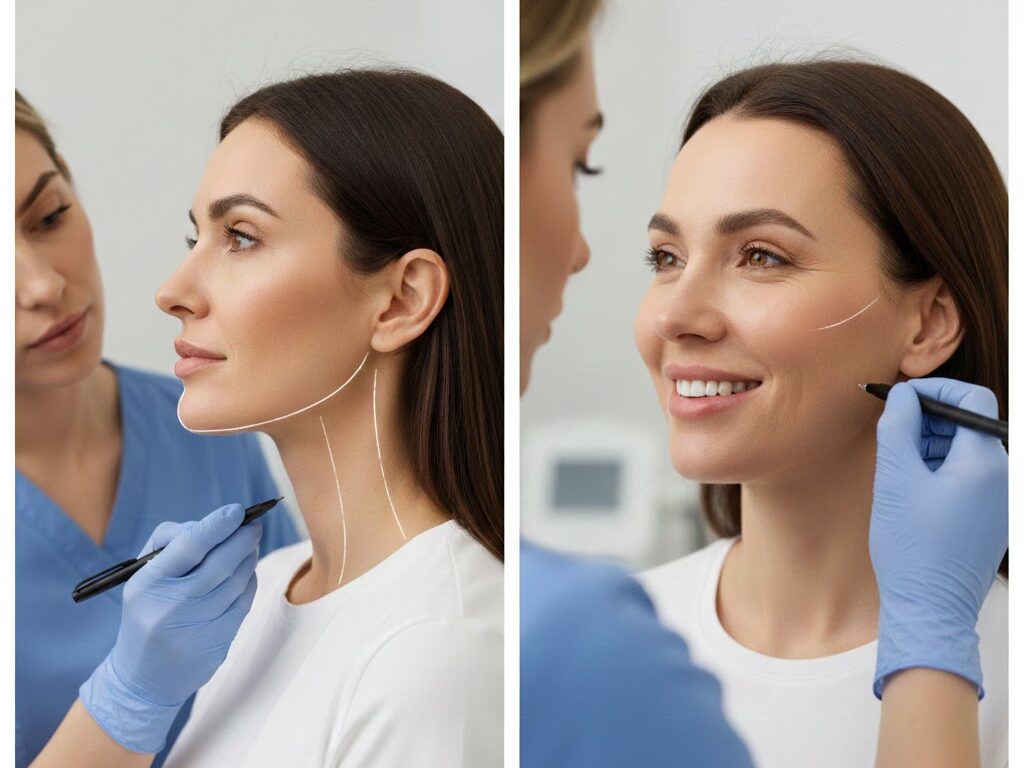
The chin does not exist in isolation. On a lateral profile, it anchors the lower third of the face and defines the visual line from the forehead to the chin tip. When projection is insufficient, the nose appears more prominent than it actually is, the jawline softens into the neck rather than cutting cleanly, and the cervicofacial angle — the visual crispness between jaw and neck — becomes less defined.
Adding even modest projection recalibrates all of these relationships simultaneously. A nose that appeared slightly large in profile reads as more proportionate. A jawline that looked undefined gains implied structure. The neck-to-jaw transition appears sharper. This cascade effect is why subtle chin filler consistently delivers improvements that feel disproportionate to the volume used.
What Subtle Chin Filler Actually Is — and How It Differs from Dramatic Augmentation
Hyaluronic Acid Filler and Why It Is the Gold Standard for Natural Chin Enhancement
Hyaluronic acid filler has become the preferred medium for natural chin enhancement because it behaves like tissue rather than an implant. HA is a substance the body already produces, which means well-placed filler integrates softly rather than sitting as a distinct, palpable mass.
How HA Filler Integrates with Facial Tissue
HA filler attracts and binds water molecules within the treatment area, creating volume that moves and compresses naturally with expression and pressure. In the chin specifically, where the underlying bone and soft tissue provide a stable structural foundation, a well-formulated HA product settles into the anatomy rather than distorting it. The result feels like refined bone structure, not added material.
The Reversibility Advantage: What Hyaluronidase Means for Your Peace of Mind
Hyaluronidase is an enzyme that dissolves HA filler within hours of injection. Its existence fundamentally changes the risk calculation for first-time patients. If a result is not what you intended — too much volume, asymmetry, or an aesthetic direction that doesn’t feel right — a qualified injector can correct or fully reverse it at a follow-up appointment. No surgical procedure offers this.
For anyone weighing the decision carefully, reversibility converts what might feel like a permanent commitment into a low-risk refinement. That distinction matters enormously.
Conservative Dosing vs. Full Augmentation: Understanding the Spectrum of Outcomes
Understanding What Different Volumes Actually Achieve
Volume is not the primary driver of quality, but it does determine the category of change. Here is a practical breakdown of what each range typically delivers:
- 0.5ml delivers micro-refinement: subtle projection, a softened mentolabial fold, and improved chin definition that reads as natural contouring. This is ideal for patients with mild recession or those new to fillers who want a conservative first result.
- 1ml produces a clearly visible but proportionate improvement in chin projection and jawline definition. This is the most common starting point for moderate chin recession and typically achieves meaningful profile improvement without exceeding natural anatomy.
- 1.5ml and above moves into structural augmentation territory. This range is appropriate for pronounced chin recession or for patients pursuing a more significant aesthetic shift, but it requires commensurately higher injector skill to maintain a natural appearance.
Most patients seeking subtle results work comfortably within the 0.5ml to 1ml range.
Why a Subtle Result Is a More Technically Demanding One
Larger volumes are paradoxically more forgiving to place. They fill the treatment area broadly, and small placement imprecisions are absorbed into the overall volume. Conservative dosing leaves no such margin. Every fraction of a milliliter matters, every placement point must account for the surrounding tissue, and the injector must visualize the settled result rather than the immediate post-injection appearance.
Achieving natural-looking definition with minimal product requires a more sophisticated understanding of facial anatomy than achieving dramatic projection with maximum product.
Is Chin Filler Subtle? Addressing the Core Anxiety Directly
Yes — when performed by a skilled injector with clearly defined conservative goals, chin filler is genuinely subtle. The most consistent feedback from patients is that friends and colleagues comment that they look well-rested or more confident, without identifying any specific change. The treatment becomes invisible. The improvement does not.
Can You Get Chin Filler That Looks Natural? The ‘Looks Like You’ Principle
Natural-looking results depend on one governing principle: the enhancement should be consistent with what your face could plausibly look like under ideal circumstances. An expert injector studies your bone structure, soft tissue distribution, and existing facial proportions before determining placement and volume. The target is not a generic aesthetic ideal — it is the best version of your specific face. That distinction is what separates a result that looks like you from one that looks like a procedure.
Subtle Refinement vs. Full Augmentation: A Side-by-Side Framework
Use this framework to identify where your goals and circumstances sit on the treatment spectrum before your consultation.
| Dimension | Subtle Refinement | Full Augmentation |
|---|---|---|
| Volume used | 0.5ml to 1ml | 1.5ml and above |
| Visible change | Perceptible to self, undetectable to others | Noticeable profile improvement visible to others |
| Downtime | Minimal, 24 to 48 hours of mild swelling | Moderate, up to one week of visible swelling and bruising possible |
| Reversibility | Fully reversible with hyaluronidase | Fully reversible, but correction requires more dissolving agent |
| Ideal candidate | Mild to moderate chin recession, first-time filler patient, professional discretion required | Pronounced chin recession, patient comfortable with visible change, prepared for structured recovery |
| Provider skill requirement | Very high, placement precision is critical with limited volume to compensate | High, larger volumes provide more margin for placement adjustment |
The critical takeaway is not which category is better, but which aligns with your goals, your anatomy, and your tolerance for visible change during recovery. A conservative first treatment that can be built upon in subsequent appointments consistently outperforms a single large correction, both aesthetically and in patient satisfaction. Most expert injectors will counsel a staged approach for precisely this reason.
Who Is the Right Candidate for Subtle Chin Enhancement?
Reading Your Facial Proportions: The Golden Ratio and the Chin-to-Nose Relationship
Facial balance follows measurable principles, and the chin’s role in those proportions is more significant than most people realize until they see their own profile. In classical facial analysis, the face divides into three roughly equal horizontal thirds: forehead to brow, brow to nasal base, and nasal base to chin tip. When the lower third is shorter or less projected than the upper two, the entire face reads as bottom-heavy or unresolved, even when the individual features themselves are attractive.
The chin-to-nose relationship is particularly telling on a lateral view. Practitioners use a vertical reference line dropped from the nasal tip, known as the Ricketts line, to evaluate whether the chin tip sits at an appropriate projection relative to the lips and nose. A chin that falls meaningfully behind this reference point typically makes the nose appear larger and the profile less refined than the actual anatomy warrants. Subtle chin filler corrects this relationship without touching anything else.

Common Concerns That Subtle Chin Filler Addresses Elegantly
A Recessed or Weak Chin and Its Effect on Perceived Nose Size
A weak chin does not just affect the chin — it distorts the perception of the entire lower face. Because the eye evaluates features relative to one another, a recessed chin amplifies the nose’s visual weight in profile. Patients who come in concerned about their nose frequently leave a chin filler consultation understanding that the nose was never the primary issue. Adding forward projection to the chin recalibrates the nose-to-chin ratio without any intervention to the nose itself, which is one of the more elegant outcomes in non-surgical aesthetics.
Softening the Mentolabial Fold and the Prejowl Area
The mentolabial fold, the crease between the lower lip and chin, deepens as the chin loses volume or as the overlying soft tissue descends with age. Strategic placement of filler into the chin body and chin pad softens this fold from below, creating a smoother transition between the lower lip and chin without the structural disruption of a surgical approach.
Similarly, the prejowl sulcus, the subtle hollow that develops on either side of the chin with age, responds well to conservative filler placement, restoring a continuous jaw-to-chin contour that frames the lower face cleanly.
Creating a V-Line Jawline Impression Through Strategic Projection
Forward chin projection naturally creates the impression of a more tapered, defined lower face, which is often described as a V-line effect. The chin acts as the visual anchor of the jawline. When it projects appropriately, the jaw appears to converge to a defined point, creating the impression of greater facial slimness even without any change to the jaw angles or cheeks. This is one of the most consistent and satisfying outcomes for patients who feel their faces lack definition but cannot articulate exactly why.
How Much Chin Filler Should I Get for My Face Shape?
Volume should follow anatomy, not a formula. The right amount for your face depends on the degree of recession, your soft tissue thickness, and the specific harmony goals established during consultation. A round or heart-shaped face may achieve V-line definition with 0.5ml. A square face may need closer to 1ml to produce visible forward projection, because the strong jaw angles require the chin to hold its own visually.
Oval faces typically have the most flexibility. An expert injector maps these variables before recommending any volume — it is a number you arrive at together during assessment, not one decided in advance.
What Is the Best Filler for a Weak Chin?
Product selection is a clinical decision, and the right answer depends on the degree of structural correction required. HA fillers in the medium-to-high cohesivity range, such as Juvederm Volux or comparable formulations designed for structural support rather than surface hydration, are the standard choice for subtle chin work. They provide the lift and projection the chin requires while remaining soft enough to settle naturally into the tissue.
Calcium hydroxylapatite products such as Radiesse offer greater structural support for patients with more pronounced recession and are appropriate when a firmer scaffold is needed, though they are not reversible with hyaluronidase. For first-time patients prioritizing natural results and a safety net of reversibility, a high-cohesivity HA filler is almost always the most appropriate starting point.
What Results Can You Realistically Expect — and When Will You See Them?
The Immediate Appointment vs. the Settled Result: A Realistic Timeline
What you see immediately after your appointment is not your final result. In the first 24 to 48 hours, mild swelling and the mechanical effect of freshly placed filler can produce a result that looks slightly more projected or defined than the settled outcome. Conversely, initial swelling can also obscure subtle refinements.
The filler integrates fully with the surrounding tissue over approximately ten to fourteen days — this is when the result reflects the injector’s actual work. Patients should reserve judgment until this window has passed, and most find the two-week result noticeably more refined and natural-looking than the day-of appearance.
Facial Harmony as a System: How Chin Projection Changes the Appearance of Surrounding Features
Once the filler settles, patients frequently notice changes that extend well beyond the chin itself. The nose reads as more proportionate in profile. The neck-to-jaw transition appears sharper. The lower face looks more defined in photographs taken at three-quarter angles.
These are not coincidental — they are the cascade effects described earlier, now perceptible in a real-world result. The chin anchors the lower third of the face, and improving that anchor improves the coherence of the entire structure above it.
Can Chin Filler Make Your Face Look Slimmer?
Chin filler does not remove volume — it redirects perceived proportion. Forward projection lengthens the visual lower third of the face, which creates the impression of a slimmer, more oval facial silhouette. This is particularly effective for rounder face shapes where the lower face reads as wide relative to its length.
By extending the chin tip forward and subtly elongating the lower face, the overall silhouette appears more tapered without changing the actual facial width. The effect is architectural rather than reductive.
Does Subtle Chin Filler Show in Photos?
A well-executed, subtle result photographs in the same way it presents in person — as a defined, naturally proportionate lower face. Photos, particularly at three-quarter angles, tend to highlight the improvements most clearly while concealing any evidence of treatment. The profile view that previously revealed chin recession now shows better balance. The frontal view conveys more definition.

Colleagues and contacts who see your photographs will register that you look sharp and well, not that anything specific has changed. This is precisely the outcome that discretion-conscious professionals need to feel confident moving forward.
The Treatment Experience: What to Expect at Your Appointment
The Consultation: The Most Important Step in the Process
A consultation focused exclusively on volume — how much do you want? — is a red flag. The most important conversation before treatment is about what facial harmony looks like for your specific anatomy and what “better” means in the context of your existing features. An expert injector uses this conversation to understand not just your aesthetic goals, but your tolerance for visible change, your lifestyle and scheduling constraints, and any previous treatments that might influence product selection or placement.
The goal the injector works toward should be a proportionality outcome, not a volume number.
How Expert Injectors Map Facial Structure Before Treatment Begins
Before treatment begins, a thorough assessment includes facial symmetry, soft-tissue thickness over the chin pad, the depth of the mentolabial fold, the degree of chin recession relative to the nasal tip and lips, and the overall lower facial contour. Many experienced injectors use standardized facial analysis frameworks and take reference photographs from multiple angles — frontal, lateral, and three-quarter — to document baseline anatomy and precisely plan placement. This assessment is not administrative. It is the clinical foundation that determines where the product goes and how much is used.
Precise Placement and Why Injection Technique Determines Everything
Chin filler is typically placed in one or more of three zones: the chin body for central projection, the chin pad for soft tissue refinement and fold softening, and occasionally along the prejowl region to restore lateral contour continuity. For subtle results, the central projection point, known anatomically as the pogonion, is usually given primary placement, with smaller amounts feathered outward to maintain a smooth, natural contour.
A skilled injector places product in controlled boluses or linear threads depending on the tissue layer targeted, then manually molds the filler to ensure even integration before evaluating the result from multiple angles. The difference between a natural result and an obvious one often comes down to whether the injector takes this final assessment step seriously.
Does Chin Filler Hurt? An Honest Account of the Experience
The chin is a manageable area for most patients. A topical numbing cream applied 20 to 30 minutes before treatment significantly reduces the initial needle sensation, and most modern HA fillers contain lidocaine, which numbs the tissue progressively as the product is deposited.
Patients typically describe the experience as a brief, sharp pressure at the injection point followed by mild pushing or tension as filler is placed. Discomfort is generally mild and short-lived. The full treatment takes less than 30 minutes from setup to completion.
Recovery, Downtime, and Planning Around Your Professional Life
The Swelling Timeline: What Happens in the First 72 Hours
Swelling peaks within the first 24 to 48 hours and resolves substantially by 72 hours for most patients. The chin area tends to swell less dramatically than the lips or cheeks due to the density of the underlying tissue, which favors the discretion-conscious patient. Mild tenderness at the injection sites is normal. Bruising is possible but not typical when performed by an experienced injector using fine-gauge needles.
Scheduling Strategy: When to Book Relative to Key Commitments
Book your appointment at least 5 to 7 days before any high-visibility event, such as an important presentation, a conference, or a professional photoshoot. A ten-day buffer is more comfortable and accounts for the full settling period.
Avoid booking immediately before events where close-up photography is planned, since the unsettled result in the first few days does not reflect the final outcome. Thursday or Friday appointments allow the initial swelling to largely resolve over the weekend.
What Side Effects Are Normal and When to Contact Your Provider
Expected side effects include localized swelling, mild tenderness, and occasional light bruising in the first two to three days, all of which resolve without intervention. Contact your provider promptly if you experience significant or asymmetric swelling that worsens after 72 hours, skin color changes suggesting vascular compromise, or unusual firmness or nodularity that develops after the first week. These are uncommon when treatment is performed correctly, but early communication with your provider ensures any concerns are addressed quickly.
Longevity, Maintenance, and the Long-Term Strategy for Subtle Results
How Long Does Chin Filler Last?
Chin filler generally lasts longer than filler placed in higher-movement areas like the lips. The chin pad experiences relatively little mechanical stress from facial expressions or chewing, so the product degrades more slowly. Most patients see results that hold well for 12 to 18 months, with some maintaining their results comfortably up to 24 months, depending on the product used, individual metabolism, and the volume placed.
Denser, higher-cohesivity formulations tend to last toward the longer end of that range. A touch-up appointment rather than a full re-treatment is often all that is needed once the initial result has settled.
Why Ongoing Subtle Refinement Delivers Better Long-Term Outcomes
A staged approach, beginning conservatively and building over successive appointments, consistently produces more natural, durable results than a single large correction. There are two reasons for this. First, the injector learns your specific tissue response: how product integrates with your anatomy and how your face looks at the two-week settled result before adding more. That information is irreplaceable. Second, subtle maintenance keeps the result continuous rather than cyclical.
When a patient waits until their filler has fully dissolved before returning, they experience a visible decline and then a noticeable change — the opposite of imperceptible refinement. A scheduled reassessment at 12 to 14 months, when the result is still present but beginning to soften, allows a smaller top-up that keeps the outcome consistently natural rather than alternating between defined and undefined.
Is Chin Filler Reversible?
Yes, HA chin filler is fully reversible. Hyaluronidase dissolves the product within hours, and the area returns to its baseline state. This matters not as a theoretical comfort, but as a practical framework for making the decision with confidence. Reversibility converts a permanent commitment into a provisional one. If your goals change, if you feel the result is slightly more than you intended, or if your circumstances shift, the option to return to baseline is always available.
For first-time patients, especially, knowing the decision can be undone at a follow-up appointment changes the emotional calculus entirely. You are not locking anything in — you are exploring a direction, with an exit available if needed.
Is Subtle Chin Filler Right for You? A Quick Confidence Check
Three indicators suggest a conservative chin enhancement consultation is a logical next step.
- Your profile concerns you more than your frontal view. If photos from the side or three-quarter angle bother you more than straight-on images, chin projection is likely the underlying variable. Subtle filler addresses exactly this.
- You are often told you look tired or undefined without knowing why. A recessed lower third reads as fatigue or lack of definition. This is one of the most common presentations that subtle chin work corrects quietly and effectively.
- You want an improvement that is perceptible to you but invisible to everyone else. If that sentence describes your goal precisely, you are the ideal candidate for a conservative, proportionality-focused approach. A consultation will confirm whether your anatomy supports it.

Why Provider Selection Is the Single Most Important Decision You Will Make
The Technical Skill Gap: Why Subtle Results Are Harder to Achieve Than Dramatic Ones
A dramatic result broadcasts its outcome regardless of placement precision. A subtle result depends entirely on the injector’s ability to visualize the final settled appearance in real time, place product in controlled amounts at the correct tissue depth, and stop before the result crosses from refined to obvious. That last judgment call — knowing exactly when enough is enough — is a clinical skill that develops over years of treating a wide range of anatomies. It is not a technique that can be learned from a certification weekend.
What a Personalized Consultation Looks Like — and Why It Cannot Be Rushed
A genuine consultation takes time. The injector reviews your facial photographs from multiple angles, discusses your specific concerns without projecting a predetermined treatment plan, and maps the relationship between your chin, nose, jawline, and neck before recommending anything. Y
ou should leave the consultation with a clear understanding of what product will be used, how much, and why — along with a frank conversation about what the result will and will not change. If a consultation feels transactional or brief, it is not the right environment for a treatment where precision is everything.
The Questions to Ask Any Injector Before Committing
Before booking, ask directly:
- How many chin filler treatments do you perform per month, and can I see a portfolio of settled results at two weeks or beyond?
- What is your default approach when a patient wants a subtle, undetectable result rather than a visible transformation?
- Which product do you recommend for my anatomy, and why that product specifically?
- What is your protocol if I am not satisfied with the outcome?
The answers reveal whether the injector thinks in terms of facial systems and individual anatomy or in terms of standard protocols applied uniformly. You want the former.
How MEDSPA MD Group’s Tailored Approach Addresses the Fear of Looking ‘Done’
MEDSPA MD Group’s approach is built around the principle that no two faces present the same problem or require the same solution. The consultation process is structured to understand your specific proportionality goals before any treatment is planned, and the emphasis on conservative, staged refinement reflects a genuine commitment to outcomes that serve your life — not outcomes that serve a before-and-after photograph.
For the professional who needs to maintain absolute discretion, the practice’s focus on personalized assessment and measured technique is not a marketing position. It is the clinical method that makes natural results reproducible rather than occasional.
Refined, Confident, Unmistakably You: The Case for Choosing Subtlety by Design
Imperceptible Refinement as the Highest Form of Aesthetic Artistry
The most sophisticated aesthetic outcome is one that requires no explanation. No one asks what you had done because nothing looks done — only you look sharper, more defined, more like the version of yourself you recognize in good photographs. Subtle chin filler achieves this not by doing less, but by demanding more: more precision in placement, more restraint in volume, more clinical intelligence in understanding how a small change at the chin propagates through the entire lower face. The treatment is quiet by design, and that quietness is the point.
Your Next Step: From Curiosity to a Confident Consultation
If you have read this far, the decision is not whether to explore subtle chin enhancement — it is whether you have found the right environment to do it well. The next step is a consultation with a provider who treats facial proportion as a system, discusses your goals in terms of harmony rather than volume, and has the clinical experience to deliver a result you will not need to explain to anyone. That conversation costs nothing and changes the entire frame of the decision. Book it with the same confidence you bring to every other deliberate, well-researched choice you make.
Frequently Asked Questions
Yes, when performed by a skilled injector with conservative, proportionality-focused goals, chin filler is genuinely subtle. The most consistent feedback from patients is that those around them notice they look more refreshed or confident, without identifying any specific change. The treatment becomes invisible — the improvement does not.
Absolutely. Natural-looking results depend on one governing principle: the enhancement should be consistent with what your face could plausibly look like under ideal circumstances. An expert injector studies your bone structure, soft tissue distribution, and existing proportions before determining placement and volume. The target is the best version of your specific face, not a generic aesthetic ideal — and that distinction is what makes the difference between a result that looks like you and one that looks like a procedure.
For most patients, a high-cohesivity hyaluronic acid filler formulated for structural support, such as Juvederm Volux or a comparable product from the Restylane range, is the most appropriate starting point. These products provide the projection and definition the chin requires while integrating softly with the surrounding tissue. Calcium hydroxylapatite fillers such as Radiesse offer a firmer scaffold for more pronounced recession but are not reversible with hyaluronidase. A qualified injector will recommend the right product based on your specific anatomy and goals.
Chin filler typically lasts between 12 and 18 months, with some patients maintaining their results comfortably up to 24 months. The chin pad experiences relatively little movement compared to areas like the lips, which means the product degrades more slowly. Longevity depends on the product used, the volume placed, and individual metabolism. A small top-up appointment around the 12 to 14-month mark is often all that is needed to maintain a consistently natural result.
There is no universal formula — the right volume follows your anatomy, not a standard prescription. As a general guide, 0.5ml typically delivers subtle micro-refinement suited to mild recession or first-time patients, while 1ml produces a more clearly visible but still proportionate improvement for moderate recession. A round or heart-shaped face may achieve meaningful definition with 0.5ml, while a square face often benefits from closer to 1ml to balance stronger jaw angles. Your injector will assess your specific proportions during consultation and recommend a volume that serves your individual facial harmony.
The most common side effects are localized swelling, mild tenderness at the injection sites, and occasionally light bruising, all of which typically resolve within two to three days. The chin area tends to swell less dramatically than areas such as the lips, which supports a more discreet recovery. More significant concerns, such as asymmetric swelling that worsens after 72 hours, skin discoloration, or unusual firmness developing after the first week, are uncommon when treatment is performed by an experienced, board-certified provider, but should be communicated to your injector promptly if they occur.
More Blogs:
- Addressing Modern Weight Management: A Science-Backed Path to Lasting Results: Discover how Semaglutide supports sustainable weight loss by regulating appetite, improving metabolic control, and delivering medically guided, long-term transformation.
- Unveiling Liquid BBL: A Modern Approach to Gluteal Enhancement: Discover how Liquid BBL reshapes and lifts the buttocks with collagen-stimulating fillers, offering natural results, minimal downtime, and tailored care.
- Unveiling Liquid BBL Injections: A Non-Surgical Revolution in Body Contouring: Liquid BBL injections use collagen-boosting fillers to enhance glute shape naturally with minimal downtime and a safe, non-surgical approach.
- Understanding the “Liquid Lift”: What Are Buttock Filler Injections?: Discover how buttock filler injections create a non-surgical “liquid lift” to enhance curves, smooth hip dips, and restore volume with minimal downtime.
- The “Instant BBL” Demystified: Modern Non-Surgical Body Contouring: Discover how non-invasive injectable treatments subtly lift, shape, and enhance buttock contours for natural-looking results with minimal downtime.
- Discovering Liquid BBL Injections: Your Gateway to Non-Surgical Body Contouring: Learn how liquid BBL injections use collagen-stimulating fillers to enhance shape and volume naturally, with minimal downtime and non-surgical results.
- Redefining Body Contours with Liquid BBL Injections Near Me: Discover how non-surgical liquid BBL injections enhance shape and volume naturally, with minimal downtime and expert-led, discreet results.
- Unveiling Liquid BBL treatment: What Is a Liquid BBL and How It Works: Discover how this advanced non-surgical procedure uses biostimulatory fillers to enhance volume, refine contours, stimulate collagen, and deliver natural-looking results with minimal downtime.
- Understanding BBL safety and Liquid BBL procedures: Learn why traditional BBL risks created safety concerns, how non-surgical Liquid BBL differs, and what makes medically supervised injectable body contouring safe.