Table of Contents
- What Are Frown Lines (Glabellar Lines)?
- How Botox Works for Frown Lines & Forehead Lines
- Botulinum Toxin Injection Process at MedSpa MD Group (Step by Step)
- Results Timeline, Before & After Expectations
- Safety, Side Effects, and Adverse Effects of Frown Lines Botox
- Who Is (and Isn’t) a Good Candidate?
- Cost of Botox for Frown Lines in 2026 (Philadelphia & Houston)
- FAQs About Frown Lines Botox
- Why Choose MedSpa MD Group
- Next Steps: Book Your Frown Lines Botox Consultation
Can Botox Really Erase Your Frown Lines?
You catch yourself on a Zoom call and notice two deep vertical lines between your eyebrows making you look angry, tired, or stressed-even though you feel fine. Whether you are a tech professional in Philadelphia staring at screens all day or a Houston-based attorney squinting through depositions, those frown lines can quietly change how people read your face.
Here is the short answer to the question everyone Googles: Botox Cosmetic (botulinum toxin type A) is an FDA approved injectable that works by temporarily relaxing the facial muscles responsible for frown lines and forehead lines, softening existing frown lines and helping prevent deeper static wrinkles from setting in. It has been a go-to cosmetic treatment since the FDA approved Botox for cosmetic use in 2002, and it remains one of the most studied aesthetic procedures in medicine.
This article focuses specifically on frown lines botox and related upper face botulinum toxin injections-not general skincare or surgical options. MedSpa MD Group provides physician-led botox treatments in Philadelphia, PA and Houston, TX, including many fly-in/fly-out clients who want a natural looking result, not a “frozen” face. Below you will learn exactly how the treatment works, what the appointment feels like, safety considerations, realistic 2026 cost ranges, and how to decide whether this is right for you.
What Are Frown Lines (Glabellar Lines) and Why Do They Form?
Frown lines are vertical creases between the eyebrows, often called glabellar lines or “11 lines” because they tend to look like the number eleven etched into your skin. They sit right above the nose, and they often appear alongside horizontal forehead lines created by a different set of muscles.
The anatomy behind them is straightforward. When you squint, concentrate, or frown, a group of glabellar muscles-the corrugator muscles (which pull the brows inward and down), the procerus (which pulls the skin between the brows downward), and the depressor supercilii-contract to create those vertical furrows. Frown lines form due to these repetitive muscle contractions happening thousands of times a year.
Frown lines initially appear during facial expressions and can become static lines over time. In your late 20s and 30s, these are mostly dynamic wrinkles: visible only during movement. But as you age and skin loses elasticity, the creases start showing at rest too-what clinicians call static wrinkles. Collagen and elastin decline accelerates in your 40s and 50s, deepening existing lines.
Several factors speed this process up. Genetics play a role in the formation of frown lines. Sun exposure can accelerate the development of frown lines, which is especially relevant in Houston’s year-round UV intensity. Stress can contribute to the development of frown lines, as can screen strain, smoking, and habitual expressions common among professionals who spend hours focusing intently. Existing frown lines vary widely-some are shallow and mostly dynamic, while deeply etched static lines may ultimately need combination treatments such as botox plus fillers or skin resurfacing for full smoothing.
How Botox Works for Frown Lines & Forehead Lines
Botox Cosmetic is a purified form of botulinum toxin type A that temporarily reduces the activity of specific targeted muscles causing frown lines and certain forehead lines. Botox is one of the most effective non-surgical treatments for dynamic frown lines, and its mechanism is well understood.
At the molecular level, botulinum toxin blocks acetylcholine release at the neuromuscular junction. More specifically, botulinum toxin cleaves SNAP-25 to inhibit muscle contraction. Without acetylcholine signaling, the nerve signals that tell those corrugator and procerus muscles to contract are interrupted. The result: temporarily relaxing those muscles smooths the overlying skin and softens facial wrinkles-particularly the vertical lines between the brows.
Botulinum toxin injections work best on dynamic wrinkles and lines and wrinkles driven by muscle contraction. Deeply etched static wrinkles may soften noticeably but may not disappear completely after a single session. That is why treating frown lines often goes hand-in-hand with carefully planned forehead botox-and sometimes crow’s feet treatment-to maintain a natural brow position and avoid a heavy or “surprised” look across the upper face.

In terms of timing, initial muscle relaxation from Botox usually begins to show within 3 to 7 days. The maximum effect of Botox is typically observed about two weeks after treatment. Botox effects typically last between three to six months, with most patients finding results hold for about 3 to 4 months before muscle activity gradually returns. Botox can also prevent new wrinkles from forming by limiting muscle movement, making regular botox treatments a preventive strategy as well as a corrective one.
Multiple FDA approved botulinum toxin products exist (Botox Cosmetic, Dysport, Xeomin, and the newer LETYBO approved in 2024), and dosing is not interchangeable between brands. Your injector at MedSpa MD Group selects the product based on your facial anatomy, aesthetic goals, and past response.
Botulinum Toxin Injection Process at MedSpa MD Group (Step by Step)
Here is what to expect when you book frown lines botox at MedSpa MD Group in Philadelphia or Houston.
Consultation. Your provider reviews your medical history, previous botulinum toxin injections, medications (especially blood thinners), and goals. They examine your brow position, muscle strength, and existing lines using a mirror while you make various facial expressions-frowning, raising your eyebrows, and squinting-to map where the corrugator muscles and procerus are most active.
Treatment plan. An individualized botox treatment plan is created. Botox injections typically require 20 units for frown lines, split across five injection sites (4 units per injection site), though your dose may be adjusted based on muscle strength, gender, and prior results. If forehead botox or crow’s feet lines treatment is needed for balance, those are discussed and quoted separately.
Day-of preparation. Your skin is cleansed, and a topical numbing cream can be applied to minimize discomfort for sensitive patients. The provider marks precise injection points in the glabellar area and, if applicable, across the frontalis muscle and lateral crow’s feet zones.
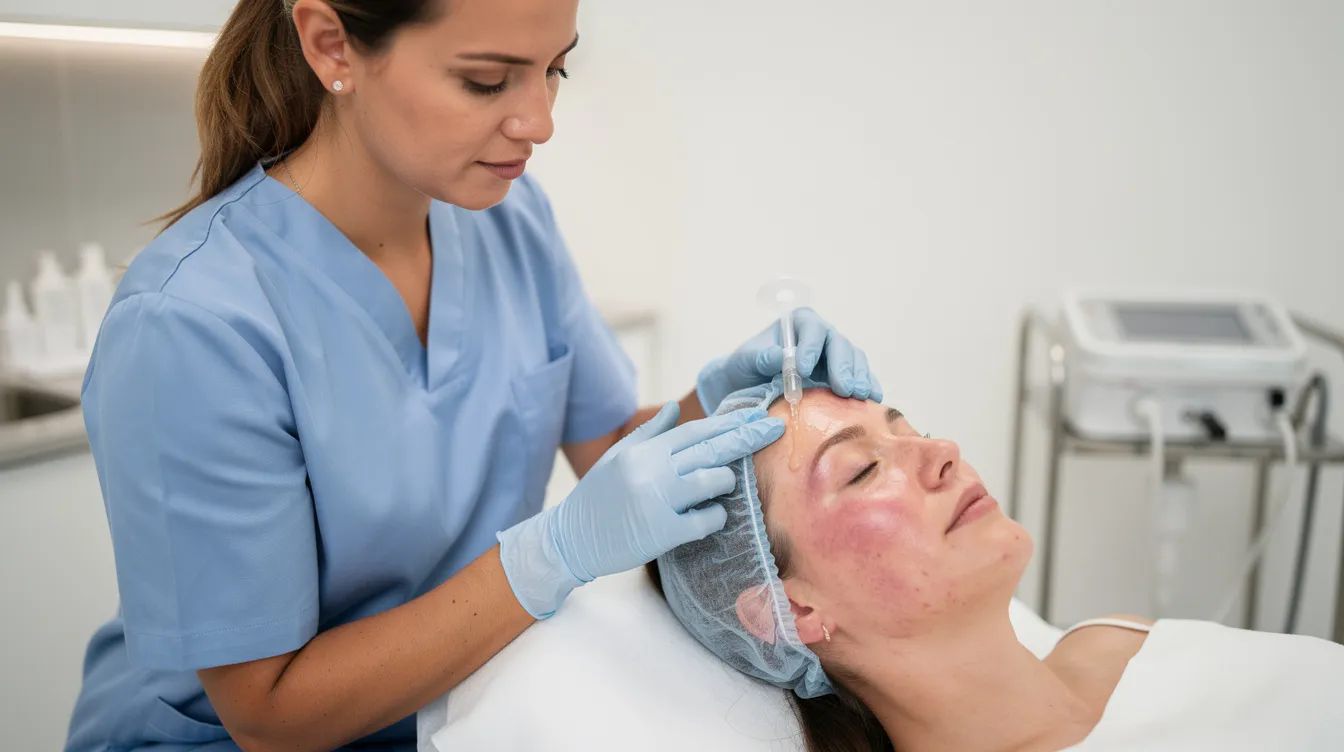
The injections. Botox treatment typically takes 10 to 20 minutes and has virtually no downtime. Using a very fine needle, the provider delivers multiple tiny injections into the corrugator muscles and procerus. Most patients describe the sensation as small pinches-brief and very manageable. If forehead lines or crow’s feet are included, additional sites are injected during the same session.
Immediate aftercare. You will be advised to stay upright and after Botox, avoid lying down for four hours. Avoid pressing or rubbing the injection area and the treated area. Skip intense workouts, saunas, and hot yoga that same day. Mild redness or tiny bumps at injection points are normal and typically resolve within an hour or two.
Results Timeline, Before & After, and How Long Botox Lasts
Most patients notice a clear softening of their frown lines after a single session, though deeply etched existing lines may take multiple treatments to reach their best appearance.
Here is a practical timeline of what to expect:
| Timeframe | What Happens |
|---|---|
| Day 0 | Mild redness or tiny bumps at injection points; resolves within 1–2 hours |
| Days 2–4 | Early softening of frown lines as muscle activity starts to decrease; Botox reduces frown lines within days after injection |
| Days 7–14 | Peak effect arrives; maximal reduction of wrinkles is visible two weeks after injection-ideal time for “after” photos and any touch-up evaluation |
| Months 3–4 | Muscle activity gradually returns; results from Botox injections generally last between 3 to 4 months, with some patients enjoying results up to 5–6 months |
In before-and-after comparisons, clients typically see less severe “11s,” a smoother glabellar area at rest, softer forehead lines, and a more relaxed appearance that reads as approachable rather than tired or angry. Natural movement and expression are preserved when dosing is done correctly.
For deeply etched facial lines that leave a faint shadow even at peak effect, adjunct cosmetic treatments like microneedling with PRP, skin rejuvenation lasers, or strategic facial fillers can provide more dramatic smoothing. Regular Botox treatments can prevent dynamic frown lines from becoming static wrinkles, and consistent sessions over 1–2 years often allow some clients to extend intervals as a stable pattern emerges.
Individual variability matters. Metabolism, muscle strength, age, and lifestyle-intense exercise, for instance-can all affect how long results last. Results from Botox can last between 3 to 6 months depending on these factors.
Safety, Side Effects, and Adverse Effects of Frown Lines Botox
Botox for glabellar lines and forehead lines has been used for decades and is backed by extensive clinical trials and clinical studies. But it is still a medical procedure. To minimize risks, treatment should be administered by qualified professionals who understand facial anatomy and injection technique.
Common reactions. Mild pain, swelling, redness, tenderness, or bruising are common local reactions after botox injections. Most resolve within hours to a few days. Mild bruising occurs in 10% to 20% of patients. At MedSpa MD Group, fine needles, gentle technique, and ice application help keep discomfort and bruising to a minimum.
Less common adverse effects. Incorrect placement of Botox injections can lead to facial asymmetry or an unnatural appearance. Temporary eyelid droop (ptosis) occurs in 1% to 5% of cases and is almost always temporary, resolving over several weeks. Headaches can occur after Botox injections, lasting a few days, though clinical trials show headache rates are similar between treatment and placebo groups.
Rare but important. Infection is rare but possible with any injection procedure. Distant spread of toxin can cause serious complications, though rare-this is why disclosure of neuromuscular disorders, pregnancy, breastfeeding, and current medications is critical before treatment. Botox treatment may not be suitable for individuals with certain neuromuscular disorders or infections at the injection site.
Prevention tips for patients:
- Patients should avoid blood thinners two weeks before treatment (including high-dose fish oil, aspirin for non-cardiac reasons) when medically safe
- Do not massage or rub the treated area afterward
- Stay upright for at least four hours post-procedure
- Avoid pressing on the injection area or the skin around the eyebrows
- Skip alcohol for 24 hours before and after to reduce bruising risk
At MedSpa MD Group, all botox treatments are physician-led or supervised, with conservative dosing for first-time clients to deliver noticeable improvement while reducing the risk of adverse effects.
Who Is (and Isn’t) a Good Candidate for Frown Lines Botox?
Good candidates include adults 18 and older who are bothered by their frown lines or forehead lines, have realistic expectations, and want a non-surgical, minimal-downtime option for facial wrinkles. This spans a wide range:
- Patients in their late 20s or 30s using Botox preventively to slow the formation of static wrinkles before they become permanent
- Clients in their 40s–60s pairing Botox with other facial rejuvenation treatments for more advanced signs of aging
- Anyone whose frown lines are primarily dynamic-deepening only during expression-who wants a softer, more relaxed appearance
Who should proceed with caution or skip treatment:
- Individuals who are pregnant or breastfeeding
- Those with neuromuscular disorders such as myasthenia gravis
- Anyone with active skin infection in the treatment area
- Patients who have had a prior severe reaction to botulinum toxin
- Individuals with unrealistic expectations (e.g., wanting zero natural movement or a completely new face)

During your consultation, MedSpa MD Group providers will honestly advise you if Botox alone is not the best solution. For example, significant skin laxity or volume loss may mean a non-surgical facelift, dermal fillers, or Endolift would better address your concerns. If you are unsure, schedule a consult-in-person or virtual-to have your frown lines, forehead lines, bunny lines, and overall facial anatomy evaluated rather than self-diagnosing candidacy.
Cost of Botox for Frown Lines in 2026 (Philadelphia & Houston)
Cosmetic botulinum toxin injections for frown lines are elective and not covered by insurance. Here is what to expect financially.
Botox treatments for frown lines cost between $200 and $1,200 per session, depending on unit count, provider level, and geographic market. Fees for Botox injections range from $250 to $550 per area, with higher totals when combining frown lines, forehead lines, and crow’s feet lines in the same visit.
MedSpa MD Group uses transparent, per-unit pricing so clients understand exactly what they pay for. The average Botox dose for frown lines is 20 units. At typical per-unit rates in Philadelphia and Houston ($10–$25 per unit depending on the clinic), a standard glabellar session might fall in the $200–$500 range, while a full upper face session (glabellar + forehead + crow’s feet, up to 64 units) costs proportionally more.
Because Botox effects typically last 3 to 6 months after treatment, most patients schedule 3–4 sessions per year for maintenance. That puts annual investment for frown lines alone at roughly $600–$2,000-significantly less than surgical options, with the added benefit of gradual, adjustable, low-downtime treatments.
MedSpa MD Group provides itemized quotes before treatment and offers bundle pricing when treating multiple facial areas. Contact us to schedule a consultation or call for a personalized quote, especially if you plan to combine frown lines botox with fillers or microneedling with PRP.
FAQs About Frown Lines Botox
Below are the most common real-world questions MedSpa MD Group receives from clients in Philadelphia and Houston.
How many Botox units do I need for frown lines?
The FDA-recommended dose for moderate to severe glabellar lines is 20 units of Botox Cosmetic, typically split across five injection sites. However, actual dosing may be slightly higher or lower depending on your muscle strength, gender, and aesthetic goals. MedSpa MD Group customizes units based on your facial assessment rather than using a one-size-fits-all formula. Botox injections are quick and require minimal downtime regardless of total units injected.
Will Botox for frown lines also help my forehead wrinkles?
Treating only the glabellar area improves the vertical “11s,” but horizontal forehead lines are created by a different muscle-the frontalis muscle. Many patients benefit from combined glabellar and forehead botox for smoother, more balanced results. Experienced injectors often treat both areas together to avoid unnatural brow shapes or heaviness, preserving natural movement across your forehead.
How soon will I see results and how long will they last?
Noticeable changes can start within 2–4 days, with full results visible around 10–14 days. Typical duration for frown lines is about 3 to 4 months, sometimes extending up to several months with consistent treatments. First-time users may notice changes more gradually as they adjust to reduced muscle contraction in the area.
Will I look “frozen” or unnatural after Botox?
A “frozen” look is usually the result of over-treatment or poor technique. MedSpa MD Group’s approach softens harsh creases while preserving your natural eyebrow movement and expression. Conservative initial dosing and follow-up adjustments help new clients achieve a smile and expression that still look like them-just more refreshed.
What should I avoid after getting botulinum toxin injections?
After treatment, avoid rubbing or massaging the treated area. Stay upright for about four hours. Skip strenuous workouts, saunas, and hot yoga that day. Avoid alcohol shortly before and after treatment to minimize bruising. Makeup can usually be applied gently after a few hours if there is no irritation at the injection site.
Can Botox fully erase deep, existing frown lines?
Botox is excellent at relaxing the muscles that cause frown lines, which often makes existing lines much less visible. However, very deep, longstanding static wrinkles may still be faintly noticeable even when the muscles are fully relaxed. In those cases, providers may recommend skin resurfacing, microneedling with PRP, or targeted fillers to smooth the etched-in crease while Botox prevents further deepening.
Why Choose MedSpa MD Group for Frown Lines Botox in Philadelphia & Houston
MedSpa MD Group is a physician-led, non-surgical medspa specializing in modern facial rejuvenation for clients locally in Philadelphia and Houston as well as out-of-state travelers. Patients should consult with qualified medical professionals before receiving Botox, and that principle guides every interaction here.
Our treatment philosophy prioritizes natural, age-appropriate results. We prefer subtle softening over frozen faces, carefully balancing frown lines, forehead lines, and surrounding areas so your facial expressions remain genuine and your appearance simply looks rested. Every treatment plan accounts for individual facial anatomy-including diverse skin tones and facial features common across our Philadelphia and Houston client bases.
Beyond frown lines botox, we offer complementary aesthetic procedures that can be combined into comprehensive plans: facial fillers, non-surgical facelift approaches, Endolift, microneedling with PRP, and skin rejuvenation. Transparent pricing, itemized quotes, pre- and post-treatment photos, and flexible scheduling for busy professionals or fly-in/fly-out clients are standard. Our convenient locations serve clients from Center City Philadelphia, the Main Line, and surrounding Houston suburbs.
Next Steps: Book Your Frown Lines Botox Consultation
If you are tired of those frown lines making you look stressed, angry, or older than you feel, the next step is simple: stop wondering and find out for certain whether Botox is right for you.
You can call MedSpa MD Group’s nearest location in Philadelphia or Houston, submit an online booking form, or request a virtual consult if you are considering travel. During your consultation, you will receive a personalized assessment of your frown lines, a review of your medical history, a transparent discussion of botulinum toxin injection options (and other treatments if helpful), clear pricing, and a realistic preview of expected results and maintenance schedule.
Bring photos of outcomes you admire and any questions about procedure time, downtime, or combining treatments so you leave feeling confident. Subtle, safely performed Botox can help you look more relaxed and refreshed-like yourself on your best day-without surgery, without a long recovery, and with results that are noticeable in the best possible way.