Table of Contents
- Introduction: Botox vs Dysport
- Dysport vs Botox at a Glance
- How Dysport and Botox Work to Smooth Wrinkles
- Key Differences Between Dysport and Botox
- Where Each Shines: Forehead Lines, Frown Lines, and Crow’s Feet
- Safety, Side Effects, and Who Is a Good Candidate
- Who Might Prefer Dysport vs Who Might Prefer Botox?
- What to Expect During Treatment at MedSpa MD Group
- Cost, Value, and Maintenance Planning
- FAQs About Dysport vs Botox
- Why Choose MedSpa MD Group
- Ready to Smooth Lines? Schedule Your Consultation
Detailed answers about Botox, what’s the difference from Dysport, and how to pick the right one for your face start below.
Introduction: Botox vs Dysport – Which Is Better for Your Lines?
If you have noticed forehead lines deepening, vertical lines forming between your brows, or crow’s feet fanning out from squinting, you have likely seen both Dysport and Botox mentioned in the same breath. Choosing between them can feel confusing when the marketing makes each sound identical.
Both botox and dysport are injectable treatments used at MedSpa MD Group in Philadelphia and Houston to treat facial wrinkles and smooth fine lines with minimal downtime. They share the same core active ingredient, botulinum toxin type A, but their formulation differences affect spread, onset speed, and ideal treatment area.
This article covers key differences in results, safety profiles, cost, and how MedSpa MD Group builds a personalized treatment plan based on your facial anatomy, muscle tone, and treatment goals. Everything here reflects 2026 clinical practices and real treatment patterns from our Philadelphia, PA and Houston, TX locations.
Dysport vs Botox at a Glance
Here is a quick reference before the deeper breakdown.
| Feature | Dysport | Botox |
|---|---|---|
| Active ingredient | AbobotulinumtoxinA | OnabotulinumtoxinA |
| Onset | ~24–72 hours; some Dysport patients notice improvement within 24 hours | ~3–7 days; full Botox effects may take up to 14 days to develop |
| Typical duration | 3 to 4 months | 3 to 6 months |
| Spread | More diffuse, covers broader areas | More localized, stays near injection site |
| FDA cosmetic approvals | Moderate to severe glabellar lines | Glabellar lines, forehead lines, crow’s feet |
One unit of Botox equals approximately 2.5–3 units of Dysport, so unit counts between the two are never a direct comparison. Dysport vs Botox is less about “better or worse” and more about matching the product to your wrinkle pattern and goals.
MedSpa MD Group offers both options and often uses them in slightly different ways to smooth wrinkles while preserving natural movement.
How Dysport and Botox Work to Smooth Wrinkles
Neuromodulators are injectable treatments that temporarily relax specific facial muscles to soften dynamic wrinkles, the creases formed by repeated expressions like frowning, squinting, and raising your brows. They do not fill the skin or add volume the way dermal fillers do.
Both are forms of botulinum toxin that work by temporarily blocking nerve signals to specific muscles. Reduced muscle contractions let the overlying skin rest, which helps smooth fine lines and can prevent deeper creases from forming over time. Botox features a larger molecular weight, which helps it stay localized at the injection site. Dysport’s formulation allows it to spread more than Botox, covering broader muscle groups.
Dynamic wrinkles typically appear as horizontal forehead lines (frontalis muscle), frown lines or glabellar lines between the brows (corrugator and procerus muscles), and crow’s feet around the outer eyes (orbicularis oculi). With appropriate dosing and muscle mapping, patients keep natural movement; a “frozen” look usually reflects poor technique, not the product itself. Muscle tone, skin thickness, and habits like frequent squinting in Houston’s year-round sun or frowning through bright Philadelphia winters influence how many units you need and how often treatments should be repeated.

Key Differences Between Dysport and Botox
This section answers the core question patients bring to consultations: what are the subtle differences, and which product fits me?
Formulation and spread. Dysport has a smaller protein complex and is more diluted than Botox, affecting unit requirements and allowing it to diffuse over a broader area after injection. This makes Dysport well suited for treating broader areas like a wide forehead. Botox has a more tightly clustered molecular structure and stays closer to the injection site, giving high precision for targeted wrinkle reduction in compact zones. These formulation differences are the root cause of most other distinctions between the two products.
Onset and feel. Dysport typically shows results within 2–3 days; many patients see softening within the first 24–72 hours, which is helpful for time-sensitive events. Botox results usually appear within 3–7 days, with full treatment effects settling around day 10–14. Patients often describe Botox onset as a gradual “quieting” of muscle movement.
Units and dosing. Dysport requires approximately 2.5–3 units for every Botox unit. A typical treatment for severe frown lines is 20 Botox units versus 50–60 Dysport units. At MedSpa MD Group, dosing is based on your facial structure and goals, not a generic unit count.
Duration. Dysport results typically last 3 to 4 months. Botox results generally last between 3 and 6 months. Dysport may last slightly longer in some patients compared to Botox, though both Dysport and Botox effects can vary by individual metabolism, exercise habits, and muscle strength. Results from both treatments can improve with regular use as muscles gradually lose their tendency to over-contract.
Where Each Shines: Forehead Lines, Frown Lines, and Crow’s Feet
Product choice ties directly to treatment area and individual muscle pattern.
Forehead lines. Horizontal forehead lines come from the frontalis muscle raising the brows. Dysport is ideal for larger areas like the forehead because its broader diffusion creates smooth, even coverage, treating larger surface areas with fewer injections in some cases. Botox’s precision can be better for asymmetrical brows or when a subtle “brow lift” effect is desired. Dysport’s faster onset and broader spread make it suitable for larger surface areas like the forehead.
Frown lines and glabellar lines. Dysport is FDA approved for moderate to severe frown lines (severe glabellar lines). Botox is also FDA approved for this area. Botox offers tight localization that is excellent for very strong corrugator muscles and deep vertical lines. Some patients feel Dysport softens the entire brow region more seamlessly. Dysport is FDA approved specifically and mainly for glabellar lines, while Botox has broader FDA-approved medical applications compared to Dysport, including approvals for muscle spasms, chronic migraine, and hyperhidrosis.
Crow’s feet. Botox is preferred for small, precise areas like crow’s feet and is FDA approved for this zone. Its limited spread protects nearby muscles responsible for blinking and natural smiling. An experienced medical professional can use Dysport injections around the eyes off-label when expression lines extend far laterally, but doing so requires careful technique. Dysport may require more injection points due to its spreading nature in delicate areas.
At MedSpa MD Group, injectors watch you animate, smile, frown, raise brows, before deciding where Dysport or Botox will best smooth wrinkles on specific facial muscles while preserving natural looking results.
Safety, Side Effects, and Who Is a Good Candidate
Both Dysport and Botox have strong safety records spanning over a decade of cosmetic use. Severe complications from Dysport and Botox are rare when administered by experienced professionals following evidence-based dosing.
Common, mild side effects:
- Injection site reactions are common but usually temporary: redness, swelling, and bruising
- Both products share similar common side effects including injection site pain and bruising
- A mild headache after treatment, though headaches are a rare side effect of both treatments
- Temporary tightness or heaviness in the treatment area
- Side effects usually resolve within a few days
Less common risks:
- Temporary muscle weakness may cause drooping eyelids if product migrates into unintended muscles
- Some patients may experience dry or watery eyes post-treatment
- There is a slight risk of asymmetric expression if dosing or placement is off
- In extremely rare cases, systemic botulinum toxicity symptoms (difficulty breathing, swallowing, or speaking) can occur; seek emergency medical treatment immediately if you notice these signs. Emergency medical treatment should never be delayed
Who is a good candidate? Good candidates are generally healthy adults wanting wrinkle reduction. Pregnant or breastfeeding women should avoid these treatments. Patients with neuromuscular disorders or previous reactions to botulinum toxin should disclose their full medical history and treatment history. Dysport and Botox work on all skin types with similar safety profiles.
At MedSpa MD Group, every new patient consult includes safety screening, discussion of medications, and review of prior experience with botox injections, dysport injections, or other neuromodulators.
Who Might Prefer Dysport vs Who Might Prefer Botox?
Both dysport and botox can deliver excellent wrinkle reduction. The goal is matching product to individual, not declaring a winner.
Who often prefers Dysport:
- Patients wanting faster onset for events within a week, whether weddings in Philadelphia or corporate meetings in Houston
- People with broader areas of concern, like wide forehead lines, who benefit from treating broader areas with a softer, feathered edge
- Long-term Botox users who feel their results don’t hold as long and want to test a different formulation
- Anyone who felt Botox “didn’t kick in fast enough” at a previous provider; Dysport’s quicker onset is beneficial for time-sensitive events
Who often prefers Botox:
- First-time patients seeking the most established product, backed by FDA approval across three cosmetic zones and the largest pool of long-term data
- Those concerned about product spread near the eyes or mouth, where Botox allows for greater precision in targeted treatments
- Individuals with strong, focused severe frown lines or deep glabellar grooves requiring precise targeting
- Patients planning combination treatments (e.g., Botox plus fillers or skin rejuvenation) where the injector wants ultra-controlled placement
Your ideal product can change over time. MedSpa MD Group frequently adjusts product choice across visits as muscle tone, age, and specific concerns evolve. Board certified dermatologists and plastic surgeons across the country use both products; the key factors are anatomy, goals, and injector skill.
What to Expect During Treatment at MedSpa MD Group (Philadelphia & Houston)
This section walks through a typical visit at our Philadelphia, PA or Houston, TX offices.
Consultation. Your provider evaluates your facial anatomy with photos and live assessment. She’ll explain how your muscles behave when you frown, raise brows, and squint. You discuss specific concerns, timeline (upcoming events), and any prior injectable experience. She presents recommended units, product choice (Dysport, Botox, or both), and projected results with a treatment plan tailored to your face.
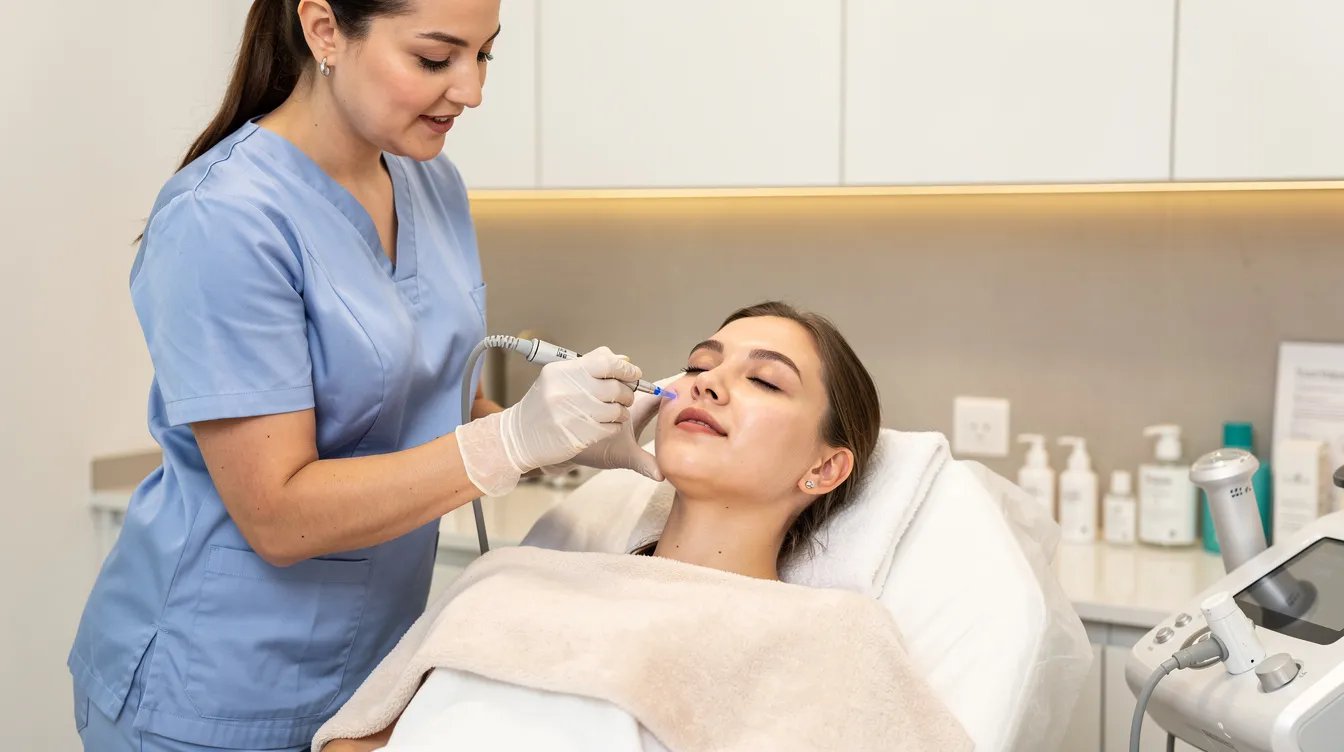
Procedure. Makeup is removed and skin is cleaned with antiseptic. Optional topical numbing or ice is applied for comfort. A series of small, quick injections with a very fine needle follows; most patients are done in 15–30 minutes. Downtime is minimal. Patients in busy urban centers like Philly and Houston routinely return to work immediately after.
Aftercare. Avoid rubbing the area, lying flat, or strenuous exercise for at least four hours. Manage rare bruising with cold compresses. Dysport results typically appear within 2–3 days; botox results usually become visible within 3–7 days, with full effect around day 14. A two-week follow-up lets us assess whether small adjustments are needed.
MedSpa MD Group also coordinates same-day or short-stay plans for clients flying in for treatment.
Cost, Value, and Maintenance Planning
MedSpa MD Group emphasizes transparent pricing for neuromodulators, just as we do for Endolift and Liquid BBL procedures.
Per-unit pricing vs total cost. Dysport is typically priced lower per unit but requires more units than Botox. Total treatment cost for a given area is usually similar. For example, treating glabellar lines alone uses roughly 20 botox units or 50 Dysport units; a 3-zone treatment (glabella, forehead, crow’s feet) uses proportionally more of either product.
Value over time. Results from most patients last 3–4 months, so returning about 3–4 times per year is standard. Regular treatments can “train” muscles to relax over time, sometimes allowing fewer injections and lower unit counts at future appointments. Combining neuromodulators with treatments like microneedling with PRP or skin rejuvenation can address both dynamic wrinkles and skin texture in a single visit plan.
Maintenance planning. Schedule your next appointment when results start to soften, not after they fully disappear, to prevent expression lines from fully rebounding. Many Philadelphia and Houston clients pre-book every 12–16 weeks to stay ahead.
Request a customized quote during your consultation with itemized units and areas so you understand your investment before proceeding.
FAQs About Dysport vs Botox
These are the questions MedSpa MD Group hears most often about dysport and botox from patients in Philadelphia and Houston.
How long do Botox and Dysport results really last?
Dysport results typically last 3 to 4 months. Botox results generally last between 3 and 6 months. Duration can vary depending on your metabolism, muscle strength, and how consistently you maintain treatments. Some patients with lighter muscle tone see results extend on the longer end.
Will I look frozen or unnatural after treatment?
Modern dosing by a skilled injector aims for softened lines with preserved natural movement, not immobility. A deep understanding of facial anatomy is what separates natural looking results from an overdone appearance. You should still be able to express surprise, concern, and happiness.
Is Dysport stronger than Botox, or vice versa?
Neither is inherently “stronger.” Dysport requires approximately 2.5–3 units for every Botox unit because of differences in dilution and molecular weight. Saying one is stronger without accounting for this conversion ratio is misleading. The right product at the right dose produces equivalent muscle relaxation.
Can I switch from Botox to Dysport or combine them?
Switching is common. Combining both in different facial zones during the same visit is also safe and effective when planned by someone with a deep understanding of each product’s unique characteristics. Many patients find that testing both helps them make an informed decision about which they prefer.
How soon before an event should I schedule treatment?
Plan at least two weeks ahead if choosing Botox to allow full treatment effects and any bruising to resolve. For Dysport, 7–10 days is usually sufficient given its faster onset. Both timelines give your provider room to make touch-ups at a follow-up if needed to achieve desired results.
Are Dysport and Botox safe for all skin tones and genders?
Yes. Both work across all skin types with similar safety profiles. MedSpa MD Group treats a diverse patient base in both Philadelphia and Houston. Side effects like temporary redness or bruising at the injection site do not vary depending on skin tone or gender.
Can I combine neuromodulators with other treatments?
Absolutely. Pairing Botox or Dysport with fillers, microneedling with PRP, or non-surgical facelift procedures is a common approach to address both dynamic wrinkles and volume loss. Your provider builds a treatment plan tailored to your full set of goals, not just treating wrinkles in isolation. This helps treat moderate to severe wrinkles and restore a youthful appearance in a coordinated way.
Why Choose MedSpa MD Group for Dysport and Botox in Philadelphia & Houston
MedSpa MD Group is a physician-led, non-surgical medspa focused on natural, non-overdone facial rejuvenation. Our providers work with both Botox and Dysport daily, plus other injectable treatments (lip, cheek, and chin fillers) and advanced procedures like Endolift, non-surgical facelift, and microneedling with PRP.
What sets us apart:
- Individualized dosing based on your muscle tone, wrinkle pattern, and lifestyle rather than a one-size-fits-all syringe count
- Transparent pricing with clear breakdowns and realistic maintenance schedules
- Two convenient locations serving Philadelphia and Houston, including fly-in coordination for patients traveling for procedures
- Familiarity with local patient needs: sun exposure driving crow’s feet in Texas, office professionals in Center City Philadelphia wanting zero visible downtime
Our clinic culture centers on a warm, consultative environment with no-pressure recommendations and a safety-first approach. Medical screening, sterile technique, and careful facial muscle mapping happen before every injection. Whether you choose Dysport, Botox, or a combination, MedSpa MD Group’s goal is refreshed, confident results that still look like you.
Ready to Smooth Lines? Schedule Your Consultation
Both Dysport and Botox can treat facial wrinkles, from forehead lines and glabellar frown lines to crow’s feet, when the product is matched correctly to your facial structure and muscle activity. The right choice depends on key factors like your anatomy, timeline, and treatment goals.
Book a personalized consultation with MedSpa MD Group to:
- Evaluate your wrinkle patterns and muscle tone with a live facial assessment
- Decide between Dysport and Botox (or a combination) based on your specific concerns and timeline
- Receive a transparent, itemized quote and a maintenance plan
Call our Philadelphia or Houston office, or request an appointment online. We offer flexible scheduling for busy professionals and those flying in for same-day treatment.
Smoother forehead lines, softer frown lines, and lighter crow’s feet are within reach. Take the next step toward feeling confident in photos, meetings, and everyday life with results that look natural and feel like you.