
Table of Contents
- Why Most Before-and-After Galleries Leave You with More Questions Than Answers
- Sculptra vs. Radiesse for Liquid BBL: Which Filler Produces Which Results
- Real Patient Scenarios: How Anatomy, Filler Choice, and Technique Shape Each Outcome
- How MEDSPA MD Group Personalizes Every Liquid BBL Treatment Plan
- Liquid BBL Longevity and Durability: How Long Do Results Actually Last
- Side Effects, Risks, and Aftercare: What Every Patient Should Know
- Liquid BBL vs. Traditional Brazilian Butt Lift: An Honest Comparison
- Conclusion: The Difference Between a Gallery and a Guarantee
- Frequently Asked Questions
Why Most Before-and-After Galleries Leave You with More Questions Than Answers
Most liquid BBL before and after pictures online share the same flaw: they show you the destination without explaining the route. You see a profile shot that improved, a curve that appeared, a silhouette that softened, but nothing about which filler was used, how many sessions it took, or why that particular anatomy responded the way it did. The result is a gallery that looks impressive and teaches you nothing.
That gap matters, because the result in front of you is the product of dozens of clinical decisions made before a single injection was placed. Without that context, you cannot evaluate whether that provider’s approach would produce the same outcome for your body. You are comparing photographs when you should be comparing reasoning.
How to Read a Liquid BBL Result Like a Practitioner
A trained eye does not look at a before-and-after photo and think “more volume.” It looks for where volume was placed, how the surrounding tissue responded, and whether the proportional relationship between waist, hip, and posterior improved or simply changed.
Projection Gains, Lateral Volume, and Overall Contour Refinement
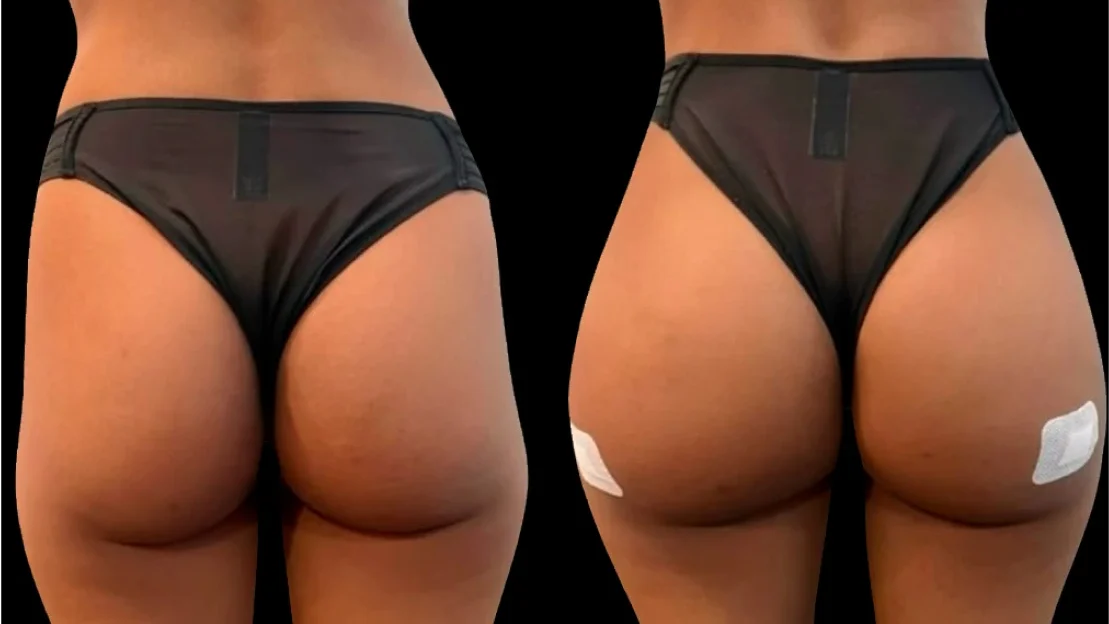
These three outcomes look different in photographs and require different injection approaches to achieve. Projection gain shows as increased distance from the lumbar curve to the posterior apex, visible in a true lateral shot. Lateral volume change fills the hip dip or trochanteric depression and reads clearly from a posterior or three-quarter view. Overall contour refinement is subtler: the smoothing of surface irregularities and the softening of transitions between body segments, often most visible in angled lighting.
A practitioner reading a result will identify which of these changed, and in what proportion. If you are evaluating a gallery, train yourself to do the same.
What “Natural-Looking” Actually Means in Clinical Terms
“Natural” is not a feeling. It is a set of measurable visual markers. A natural result preserves the patient’s native proportional relationships while improving them. The buttock apex remains in its anatomically correct position, roughly at the level of the gluteal fold. Volume distribution follows the body’s existing fat compartment geography rather than creating uniform roundness. Skin surface texture does not change, and no visible landmarks are obscured.
An overdone result often signals misplaced volume: filler placed too high creates a shelf effect, while filler placed too broadly flattens the waist-to-hip ratio instead of improving it. Natural results are recognizable because they look like the patient’s own anatomy, genuinely improved.
The Thesis Behind Every Successful Transformation
No filler produces a good result on its own. The material creates the possibility, the practitioner’s placement creates the outcome, and the patient’s anatomy determines what is possible. Every compelling non-surgical butt enhancement result you see is the convergence of all three. Filler selection that ignores anatomy produces generic outcomes. Artistic intention without the right material produces results that do not last. Anatomy assessment without artistic judgment produces technically correct but aesthetically flat work.
This is precisely why treatment planning must come before treatment.
Sculptra vs. Radiesse for Liquid BBL: Which Filler Produces Which Results
Sculptra’s Collagen-Stimulation Mechanism: The Case for Gradual, Organic Volume
Sculptra butt augmentation works through poly-L-lactic acid, a collagen stimulator that does not add volume directly. Instead, it triggers the body’s own fibroblasts to produce new collagen, and that collagen creates the volumetric change. The result develops over weeks and months, which is precisely why it looks organic rather than injected.
The Sculptra Timeline, Session by Session
- Session 1: Subtle initial swelling from the diluted solution resolves within a week. No visible volume change yet.
- Sessions 2 and 3 (typically four to six weeks apart): Collagen synthesis begins. Patients notice gradual firmness and the earliest signs of lift.
- Three to six months post-final session: Full collagen remodeling completes. This is when most patients capture their most representative after photographs.
Three sessions is a common starting protocol, though anatomy and goal complexity determine the exact number.
Can You See Results Immediately, or Do They Take Time to Develop?
With Sculptra alone, immediate visible results are not the goal. The initial fluid volume from the injection dissipates within days. Patients who choose Sculptra are choosing a result that builds, and that building process is what produces the seamless, tissue-integrated appearance that reads as natural in photographs.
Radiesse: Immediate Structure and Lift Through Hydroxyapatite Volumization
Radiesse butt filler works differently. Its calcium hydroxylapatite microspheres create immediate physical volume while simultaneously stimulating collagen production around the injection site. You see a result on the table. That initial volume softens as the carrier gel is absorbed, leaving behind a structural collagen foundation that sustains the outcome.
How Radiesse Creates Projection and Defines Contour
Radiesse’s density makes it particularly effective for structural work: creating projection in the central buttock and defining the infragluteal fold. Practitioners use it to build the framework that softer fillers or Sculptra’s collagen response then fill in. It provides lift that poly-L-lactic acid alone cannot deliver immediately.
Why Hybrid Protocols Often Outperform a Single-Filler Approach
Hybrid filler combination protocols pair Radiesse’s immediate volumization with Sculptra’s progressive collagen stimulation. The logic is additive: Radiesse establishes structure now, Sculptra builds tissue quality over time. For patients who need meaningful projection and want long-term durability, neither filler alone achieves both goals as effectively as the combination.
Filler Selection at a Glance: Sculptra vs. Radiesse vs. Hybrid Approach
| Patient Goal | Anatomy Type | Timeline Preference | Recommended Approach | Longevity Expectation |
|---|---|---|---|---|
| Gradual, organic volume gain | Adequate native tissue depth, good skin elasticity | Three to six month horizon | Sculptra series | Two-plus years with maintenance |
| Immediate projection and structure | Good subcutaneous tissue depth, localized volume deficit | Visible change within weeks | Radiesse | 12 to 18 months |
| Projection plus lateral fullness | Mixed deficit: central and lateral zones | Flexible timeline, durability a priority | Hybrid protocol | 18 to 24-plus months |
| Hip dip correction only | Isolated trochanteric depression, otherwise full posterior | Moderate timeline flexibility | Sculptra or dilute Radiesse | 18-plus months |
| Post-weight-loss contour restoration | Diffuse deflation, reduced skin elasticity | Multi-session commitment | Hybrid protocol, phased | 18 to 24 months with touch-up |
The right answer depends on all four variables simultaneously. A patient with good anatomy and a flexible timeline who wants posterior projection may achieve excellent outcomes with Sculptra alone. The same patient with a firm three-month deadline shifts the recommendation toward Radiesse or a hybrid approach. Filler selection is not a product preference. It is a clinical response to a specific set of conditions.
Real Patient Scenarios: How Anatomy, Filler Choice, and Technique Shape Each Outcome
Scenario One: Posterior Projection with Minimal Lateral Change
Assessment Logic, Filler Selection, and Session Cadence
This patient presents with adequate lateral hip volume but a flat posterior profile. Skin elasticity is good, and subcutaneous tissue depth in the central gluteal zone is sufficient to support volume. The goal is focal: increase projection at the apex without widening the silhouette.
Radiesse is selected as the primary agent. Its density allows precise placement in the central gluteal body where structural lift is needed. Volume is kept conservative at the lateral margins to preserve the patient’s existing hip-to-waist ratio. Two sessions, eight weeks apart, with a thorough assessment before any additional product placement.
What the Final Result Looked Like and Why
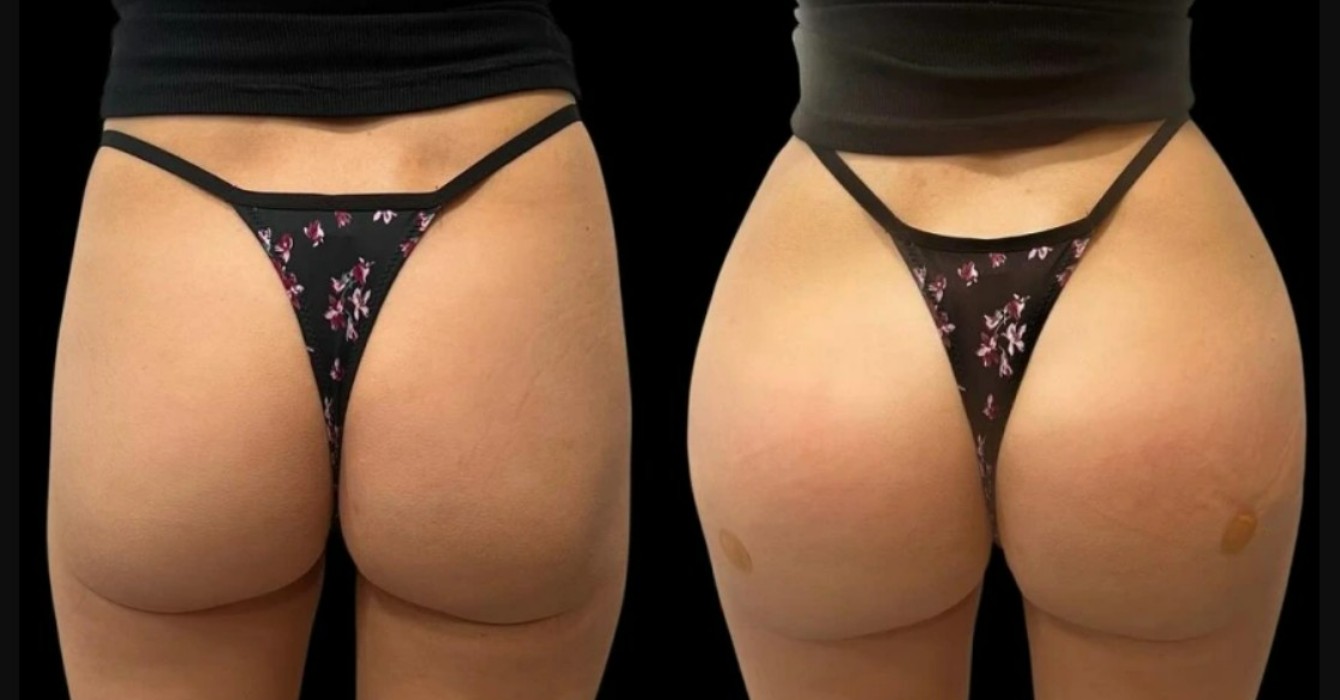
The lateral profile showed meaningful projection gain with no change to posterior width. From the posterior view, the natural hourglass relationship between waist and hip sharpened slightly because the central volume drew the eye inward. The patient’s own anatomy did the compositional work. The filler provided the structural signal it needed to do so.
Scenario Two: Hip Dip and Lateral Fullness Correction
How Hip Dip Filler Differs from Direct Buttock Augmentation
Hip dip filler correction targets the trochanteric depression, the lateral indentation between the iliac crest and the greater trochanter. This is anatomically distinct from the gluteal body. Injection here requires shallower placement, typically in the subcutaneous plane, and uses smaller volumes per site than central buttock work. The goal is contour blending, not structural lift.
Assessment Logic, Filler Selection, and Session Cadence
This patient has prominent hip dips that disrupt the lateral curve from waist to thigh, but a well-projected posterior. The priority is lateral smoothing. Sculptra is selected for its capacity to integrate with surrounding tissue and produce a gradual, surface-level volume improvement without adding unnatural firmness to a mobile body zone. Three sessions over five months allow incremental assessment so volume is added precisely where the correction is needed, without overfilling.
Scenario Three: Overall Contour Refinement After Weight Loss
Why This Profile Often Benefits Most from a Hybrid Protocol
Weight loss-related deflation affects the entire gluteal region simultaneously. Central projection drops, lateral volume reduces, and skin laxity may be present. No single filler addresses all three conditions optimally. Radiesse restores structural projection quickly and provides the lift that deflated tissue cannot self-organize. Sculptra improves tissue quality throughout the treatment zone and extends the durability of the overall result.
Assessment Logic, Filler Selection, and Session Cadence
Assessment prioritizes two things: the depth of subcutaneous tissue remaining and the degree of skin laxity present. If laxity is significant, volume targets are conservative. Overfilling lax tissue creates a heavy, drooping result rather than a lifted one. Radiesse is placed centrally in session one to restore the projection baseline. Sculptra is introduced at session two and continued across sessions three and four. The total timeline runs approximately six months.
What These Scenarios Reveal About Practitioner Decision-Making
Every decision in these scenarios, which filler, how much, where, in what sequence, follows from the assessment, not from a standard protocol applied to every patient. A practitioner who defaults to the same filler and session structure regardless of anatomy is not personalizing care. They are replicating a technique and hoping the anatomy cooperates.
The most informative question you can ask any provider is not “what filler do you use?” It is “how do you decide which filler to use?” The answer reveals the depth of clinical reasoning behind every result in their gallery.
How MEDSPA MD Group Personalizes Every Liquid BBL Treatment Plan
The Anatomy Assessment Framework: What a Thorough Practitioner Evaluates Before Injecting
The assessment that precedes treatment is where results are actually made. What happens in the injection room is the execution of decisions that should already be resolved.
Skin Laxity, Subcutaneous Tissue Depth, and Native Projection Baseline
Three anatomical variables govern what filler can achieve for a given patient. Skin laxity determines how well overlying tissue will support and display added volume. Lax skin does not lift with filler; it sags around it. Subcutaneous tissue depth determines which filler type and placement plane is appropriate. A patient with thin subcutaneous tissue needs conservative volumes and precise depth control to avoid surface irregularities. Native projection baseline establishes what improvement is realistic. A patient with some existing posterior volume responds differently to the same product and technique than one starting from near-flat.
A thorough practitioner documents all three before selecting a filler, calculating a volume target, or scheduling a session cadence.
Goal Alignment: Matching Aesthetic Objectives to Realistic Filler Outcomes
The consultation is where patients sometimes discover that their reference image represents a surgical outcome, not a filler outcome. Honest goal alignment is not about lowering expectations. It is about directing them accurately. Dermal fillers for buttocks excel at projection improvement, contour refinement, and lateral smoothing. They do not replicate the dramatic volume of fat transfer. Patients who understand this distinction before treatment consistently report higher satisfaction, because they are evaluating the actual result against the right benchmark.
Why Practitioner Credentials Matter for Non-Surgical Body Contouring
Body sculpting with filler is technically distinct from facial injection work. The treatment zones are larger, the volumes are higher, and the anatomical landmarks guiding safe deep-plane placement in the gluteal region differ from the facial anatomy that most injectors train on first.
Practitioners performing liquid BBL should have specific training in body contouring injection technique, not just general dermal filler certification. The relevant questions to ask: Have they completed advanced body contouring coursework beyond foundational filler training? How many liquid BBL procedures have they performed? Can they clearly articulate their assessment and selection rationale before you commit?
At MEDSPA MD Group, practitioners bring advanced credentials in non-surgical body contouring, with training that specifically addresses gluteal anatomy, plane-specific injection technique, and hybrid protocol design. The distinction matters because the margin between a refined result and a misplaced one is measured in millimeters and clinical judgment.
What a Realistic Candidate Profile Looks Like for Liquid BBL
The strongest candidates share a specific set of characteristics. Good skin elasticity allows tissue to lift and contour around new volume. A body weight that has been stable for at least three to six months provides a reliable anatomical baseline. Realistic expectations, specifically, understanding that this is a filler-based enhancement rather than a surgical transformation, correlate directly with outcome satisfaction.
Patients who are not well-served by liquid BBL include those with significant skin laxity, those expecting results comparable to fat transfer surgery, and those unwilling to commit to a multi-session protocol. Identifying these mismatches at consultation is a clinical responsibility, not a sales obstacle.
Liquid BBL Longevity and Durability: How Long Do Results Actually Last
Sculptra Longevity: The Collagen Remodeling Advantage
Sculptra’s durability advantage follows directly from its mechanism. Because the result is built from the patient’s own collagen rather than a foreign material, it integrates with surrounding tissue and degrades more gradually than a synthetic gel. Results consistently persist 18 months to two years, with some patients maintaining visible improvement beyond that with a single annual maintenance session.
The key variable is collagen quality, which declines with age. Younger patients with robust collagen synthesis typically see longer-lasting results from the same treatment volume.
Radiesse Longevity: Immediate Results and the Durability Window
Radiesse delivers structure immediately and sustains it as the carrier gel is absorbed and replaced by the patient’s own collagen. The typical durability window for Radiesse in body applications is 12 to 18 months for the primary volumetric effect, with some residual structural benefit persisting beyond that.
For patients who prioritize an immediate visible change, this timeline is a reasonable trade. For those whose primary concern is longevity, it is the strongest argument for a hybrid approach rather than Radiesse alone.
How Often Do You Need Touch-Ups?
Most patients on a Sculptra protocol complete their initial series and return for a single maintenance session at 12 to 18 months. Hybrid protocol patients often follow a similar maintenance schedule, since the collagen foundation built over time extends durability.
Touch-up needs vary by individual metabolism, activity level, and initial treatment volume. No filler result is permanent, but a well-planned liquid BBL does not require constant retreatment.
Thinking About Liquid BBL Investment in Terms of Monthly Value
A Sculptra series that delivers 20 months of visible results can translate to a manageable cost per month when viewed across the full duration of the outcome. Framed this way, the total investment looks different than the per-session price point suggests. Compare that to the surgical BBL’s higher upfront cost, extended recovery, and the real but rarely discussed risks of revision, and the non-surgical route’s cost profile becomes easier to evaluate honestly.
The more useful question is not “what does this cost?” but “what does this cost per month of result?” That reframe changes the comparison entirely.
Side Effects, Risks, and Aftercare: What Every Patient Should Know
Common Post-Treatment Experiences and What They Signal
Tenderness, swelling, and bruising at injection sites are the expected post-treatment responses. They signal that the tissue received product and is responding appropriately. These effects typically resolve within three to seven days. Temporary firmness at Sculptra injection sites, sometimes described as feeling like small nodules, is part of the normal inflammatory response that precedes collagen production and resolves on its own.
Is Liquid BBL Safe? Understanding the Real Risk Profile
Liquid BBL carries a materially different risk profile than surgical BBL, which has well-documented safety concerns related to fat embolism risk. Filler-based treatment eliminates the surgical risks entirely: no general anesthesia, no fat transfer, no embolism risk.
The relevant risks for non-surgical BBL are filler-specific: injection site infection (rare with proper sterile technique), product migration if placed incorrectly, and vascular occlusion if a vessel is inadvertently entered. All three are significantly mitigated by practitioner training and proper technique. This is precisely why credentials matter and why an unusually low price point should prompt scrutiny rather than confidence.
The Aftercare Protocol That Protects Your Investment
- Avoid direct pressure on treated areas for 48 to 72 hours. This means no extended sitting directly on the injection sites immediately post-treatment.
- Perform massage as directed by your practitioner after Sculptra treatment to distribute product evenly and reduce nodule formation risk.
- Avoid intense physical activity and heat exposure, including saunas and hot tubs, for 48 hours post-treatment.
- Stay well-hydrated in the days following treatment to support the tissue healing response.
Following this protocol directly affects how the filler integrates and how the final result develops.
Liquid BBL Recovery Time vs. Surgical Recovery: An Honest Comparison
Most liquid BBL patients return to normal daily activity within 24 to 48 hours. Surgical BBL patients typically require several weeks before returning to desk work and considerably longer before resuming exercise or sitting without restriction. The non-surgical option requires no drains, no compression garments, and no monitored recovery positioning.
For the patient whose schedule cannot absorb weeks of restricted activity, this difference is not a minor convenience. It is often the deciding factor.
Liquid BBL vs. Traditional Brazilian Butt Lift: An Honest Comparison
What Surgical BBL Achieves That Liquid BBL Cannot, and Vice Versa
Surgical BBL transfers autologous fat, producing volume changes that filler cannot match in magnitude. Patients seeking dramatic, large-scale augmentation are looking at outcomes that require surgical volume. Filler works within the range of enhancement and refinement, not transformation at scale.
The inverse is equally true. Surgical BBL cannot selectively smooth a surface irregularity, correct a hip dip without a full procedure, or be performed in a 45-minute appointment with no recovery. Liquid BBL does all three.
Is Liquid BBL Better Than Surgical BBL for Natural-Looking Results?
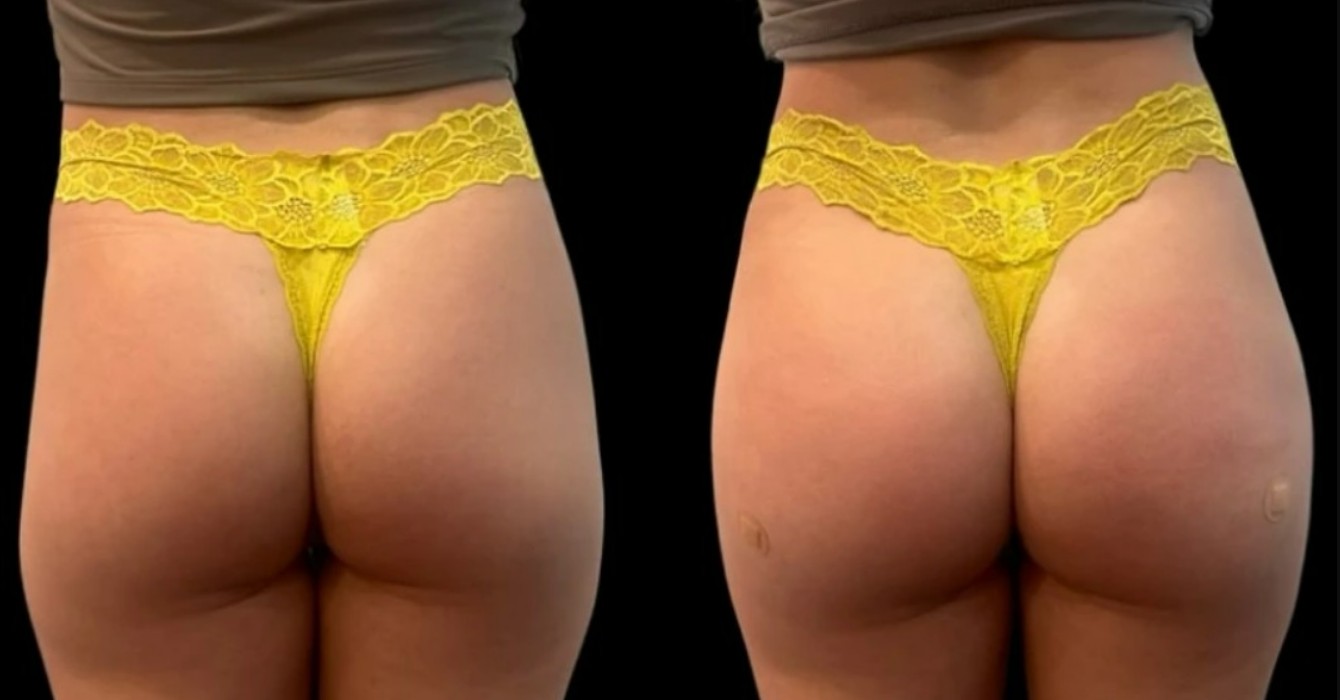
For patients seeking proportional improvement rather than dramatic size increase, liquid BBL more reliably produces results that look like the patient’s own anatomy, improved. The material integrates with tissue gradually, volume is added in controlled increments, and there is no fat reabsorption variability that can create asymmetry during healing.
Surgical BBL results depend heavily on how transplanted fat survives, which varies by patient, technique, and post-operative care. Liquid BBL results are more predictable in the natural-looking range because the mechanism is incremental by design.
Who Is Genuinely Better Served by the Non-Surgical Route
The ideal liquid BBL candidate is not simply someone who wants to avoid surgery. She is someone whose goals are achievable within the range that filler can deliver: projection improvement, contour refinement, hip dip correction, or gradual tissue quality enhancement. She values a result that builds over time, fits into her schedule, and can be adjusted as her body or preferences evolve., and she understands that refinement is a process, not a single appointment.
Patients who arrive having reviewed liquid BBL before and after pictures and recognized that those results match their own goals, rather than results from a surgical gallery, are the patients most likely to leave their final session satisfied.
Conclusion: The Difference Between a Gallery and a Guarantee
Why Meaningful Results Are Engineered, Not Applied
A liquid BBL result is engineered, not applied. Every compelling transformation in a credible before-and-after gallery reflects a sequence of deliberate decisions: an anatomy assessment that documented skin laxity, tissue depth, and projection baseline before a single product was selected; a filler choice matched to the specific deficit and the patient’s timeline; a session cadence calibrated to how the tissue responds. What you see in the photograph is the visible outcome of that clinical process.
Galleries that omit this context are not just uninformative. They are misleading. They suggest that any provider with a syringe can replicate the result, when the result was actually produced by clinical reasoning that no photograph can convey. Understanding the difference is what allows you to evaluate providers accurately rather than just aesthetically.
What to Bring to Your MEDSPA MD Group Consultation
Come prepared with reference images you find compelling from the liquid BBL before and after pictures you have reviewed, but also with a clear sense of what specifically you want to change. “More curve” is a starting point. “I want projection improvement in the central posterior without widening my silhouette” is a clinical brief that a practitioner can work from immediately.
Expect the consultation to cover your anatomical assessment, a frank discussion of what filler can realistically achieve for your specific body, a proposed filler selection and session plan, and a timeline for when you can expect to see the result develop. If a consultation skips any of those elements and moves directly to booking, slow down and ask the questions this article has equipped you to ask.
Book Your Personalized Liquid BBL Assessment
The gap between a photograph that interests you and a result that satisfies you is a consultation. Contact MEDSPA MD Group to schedule your personalized liquid BBL assessment and begin the conversation that makes the difference.
Frequently Asked Questions
Longevity depends on the filler used and the individual patient’s tissue response. Sculptra results, built from your own collagen, typically last 18 months to two years, with some patients maintaining visible improvement beyond that through a single annual maintenance session. Radiesse delivers a primary volumetric effect that generally lasts 12 to 18 months. A hybrid protocol combining both approaches often extends durability to 18 to 24-plus months, making it the strongest option for patients prioritizing long-term results.
Sculptra is a collagen stimulator that works gradually, triggering your body to produce new collagen over several months. The result builds naturally and tends to last longer. Radiesse is a hydroxyapatite-based filler that creates immediate physical volume and structural lift, with results visible from the first session. The choice between them depends on your goals, timeline, and anatomy. Patients who need visible change quickly tend toward Radiesse, while those who can invest time in a gradual process often achieve the most seamlessly natural outcomes with Sculptra.
With Radiesse, meaningful structural results are visible almost immediately after treatment. With Sculptra, the initial injection fluid dissipates within days and the collagen-building process takes three to six months to complete after the final session. Hybrid protocols offer the best of both: early visible structure from Radiesse alongside the progressive tissue improvement that Sculptra delivers over time.
Common post-treatment experiences include temporary tenderness, swelling, and bruising at injection sites, which typically resolve within three to seven days. Sculptra may produce temporary firmness or small nodules that resolve on their own. More serious risks, including infection, product migration, and vascular occlusion, are rare and significantly reduced when treatment is performed by a credentialed practitioner with specific training in body contouring injection technique.
Most liquid BBL patients return to normal daily activity within 24 to 48 hours. There are no drains, compression garments, or prolonged recovery positioning requirements. By contrast, surgical BBL typically involves several weeks before returning to desk work and considerably longer before resuming exercise or unrestricted sitting. For patients whose professional and personal schedules cannot accommodate extended downtime, the non-surgical route is a meaningful distinction.
For patients seeking proportional enhancement rather than dramatic volume increase, liquid BBL often produces results that more reliably look like their own anatomy, improved. Volume is added incrementally, the material integrates with tissue gradually, and there is no variability from fat reabsorption during healing. Surgical BBL remains the appropriate choice for patients seeking significant augmentation that filler cannot replicate in magnitude. The better question is which option aligns with your specific goal, and that begins with an honest assessment of what each approach can realistically achieve.